
Home > News > Condensation management finally makes it into the NCC before humankind lands on Mars

Condensation management finally makes it into the NCC before humankind lands on Mars

condensation_Hero_banner

Almost 50 years since the first moon landing, we continue to add, each and every day, to a legacy of buildings that risk the health of their occupants, but condensation does not make headline news. 

Thank you for reading this post, don't forget to subscribe!

Discussions about condensation often focus on insulation, sarking and ventilation, but the new requirements of Parts F6 and 3.8.7 of the NCC 2019 rightly can be found under the Health and Amenity headings of the new code.

As occupants of damp and mouldy buildings are aware, the indoor environmental quality (IEQ) where Australians spend on average 90% of our lives, has a huge impact on our health, our quality of life, the demands on our public health system, and learning outcomes from our education system.

The Australian Building Codes Board (ABCB) conducted in 2015 a Scoping Study of Condensation in Residential Buildings. The report was completed in September 2016 but it took a further year before the frightening, but not unexpected findings were made public by the ABCB.

“Based on the nationwide condensation survey, more than 40% of new buildings have condensation and mould.” [1]

The amount of moisture trapped within buildings has been linked to compromised structural systems, loss of inbuilt fabric durability, financial hardship to occupants, family breakdown and significant chronic diseases like asthma and other allergy and immunology conditions.

The report also found that costs associated with the long-term human health implications from condensation and mould within buildings, far outweigh the costs to implement regulatory, design, construction practice, and material choice changes.

At a recent launch event of the new code, the ABCB indicated the introduction of condensation management to the NCC was not a “magic cure,” that measures were only “a minimum standard” and indicated that quite likely, more changes will be introduced in 2022.

The new deemed to satisfy requirements are still limited in scope and can be summarised as: 

(1) a requirement in cool and temperate climate zones 6, 7 & 8 that sarking must be vapour permeable to improve the chances of vapour safely escaping the building envelope.

(2) a requirement for ventilation of the roof space, if for some unforeseen reason there is a  need or desire to have exhaust ventilation discharge into the roof space.

(3) requirements for minimum flow rates for exhausts in high moisture zones such as bathrooms, kitchens and laundries.

That such commonsense requirements need introducing to a mandatory code in 2019 is in itself a damning indictment about what is currently being built by some. For most good designers, the hurdle is so low that meeting these requirements will be easy, but that is no reason for complacency. The next phase of the code can’t come soon enough if we are to make any serious inroads to resolving condensation related problems in our buildings. 

Windows are part of the solution

Condensation seen in the built environment is almost always a result of one or a combination of three circumstances:

(1) the presence of moisture levels which are too high;

(2) the presence of temperatures in the building fabric which are too low; and

(3) uncontrolled flow of water vapour from a source to a region of cold temperature (cold condensing surface).

The most familiar condensing surfaces in a building are windows. Window frames and glazing can be cold impermeable surfaces, exposed to high levels of indoor humidity and where condensation is also clearly visible to occupants. Condensation can be mitigated here by using double glazing and thermally broken window frames to keep the surface temperature above indoor dew point. 

Seeing condensation on windows is a useful warning sign that more sinister and damaging condensation could be occurring unseen within the wall, roof and floor elements of the building. 

Windows play a key role in managing IEQ. The requirement for operable windows to account for 5% of the floor area should, if opened, provide natural ventilation that replaces or dilutes polluted indoor air. Outdoor air typically has lower absolute humidity than indoor air so the opening of operable windows will also work to reduce indoor moisture levels.

Unfortunately for many valid reasons such as security, noise and cold drafts, windows are not opened, leading to a build-up of indoor air pollution and high moisture levels contributing to condensation issues. The mechanical ventilation code requires for the provision of makeup air to replace air exhausted from the laundry, kitchen and bathrooms. This can be provided by trickle ventilators such as AWS Trickle Vent incorporated into the window, providing for outdoor air all day, every day, even when windows remain closed.

With innovations such as AWS Trickle Vent, a greater level of understanding across the industry, an acceleration of mandatory regulation and probably a few more court cases, we might even solve the majority of issues before we land on Mars. 


Written by: Andy Russell of Proctor Group Australia 

Dewsbury M, Law T, Potgieter J, Fitz-Gerald D, McComish B, Chandler T and Soudan A. “Scoping study of condensation in residential buildings – Final report” Australian Building Codes Board; Department of Industry Innovation and Science, University of Tasmania, September 2016.

Recent News

After a demanding year for many across our communities, AWS is proud to share that we have made a festive season donation to OzHarvest, Australia’s leading food rescue organisation, which will provide thousands of meals to Australians in need.

Thank you for reading this post, don't forget to subscribe!

A growing need in our communities

Food insecurity in Australia is rising at an alarming rate. Last year, an estimated 3.5 million households struggled to put food on the table, with the cost of living now the number one driver of hardship. The charities OzHarvest supports say they could distribute double the amount of food to meet demand. Every day, new people are turning up for help, often feeling ashamed or embarrassed to ask.

James from St Albans Community Youth Club in Victoria, which receives OzHarvest food weekly, put it simply: “For the first time in 10 years, we’re struggling to feed everyone.”

Why the festive season matters

The festive period can be especially difficult for families who do not know where their next meal is coming from. Demand typically spikes at this time of year, even as household budgets are stretched further. OzHarvest is working hard to ensure nourishing food reaches those who need it most, not just during the holidays but all year round.

About OzHarvest

OzHarvest was founded in 2004 by Ronni Kahn AO, after she noticed how much quality food was going to waste through her events business. What began as a simple, practical solution rescuing surplus food and delivering it to charities quickly grew from one van in Sydney into a nationwide movement. As OzHarvest expanded, Ronni and a team of pro bono lawyers successfully lobbied state governments to change legislation so food donors could give surplus food to charities without fear of liability. NSW led the way with the Civil Liabilities Amendment Act in 2005, and other states followed.

Today, OzHarvest rescues food at scale with a clear purpose to Nourish Our Country. Their mission is to stop food waste, feed people in need, and protect our planet by championing the value of food and driving change at every level of society. Their work strongly aligns with five United Nations Sustainable Development Goals.

How you can help (if you would like to)

OzHarvest welcomes every contribution. The impact is immediate and tangible.

  • $1 = 2 meals
  • Your donation helps keep OzHarvest’s wheels turning
  • It supports food relief for over 1,500 charities helping vulnerable Aussies every day

For more information or to make a donation visit: https://www.ozharvest.org/

Image credit: OzHarvest


Architectural Window Systems (AWS) is proud to sponsor the Murcutt Building Tours, a centrepiece of the inaugural Glenn Murcutt Architecture Foundation Symposium, to be held in Sydney from 11 – 13 September 2025.

Thank you for reading this post, don't forget to subscribe!

The Symposium, presented by the Murcutt Foundation, celebrates more than five decades of architectural practice by Glenn Murcutt AO, Australia’s most celebrated living architect. The program offers three days of tours, talks and events for architects, students and design professionals, culminating in a rare opportunity to engage directly with some of Murcutt’s most acclaimed works.

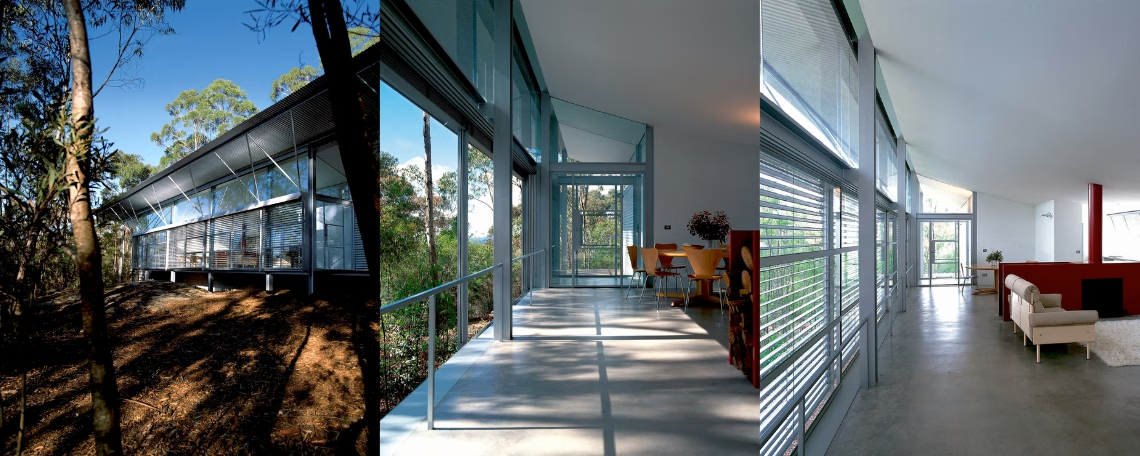
As part of its ongoing support for architectural excellence and sustainable, place-based design, AWS is sponsoring the Murcutt Building Tours on Thursday, 11 September, providing a rare, guided experience led by Murcutt himself through two iconic residential projects:

  • Nicholas House
  • Simpson Lee House

“I am so pleased that so many have taken the chance to see these two projects that were designed in such close collaboration with the clients at the time, and which have been so well loved and cared for over the many decades since. It is such a joy to share this work,” Glenn Murcutt AO.

“Glenn Murcutt’s works embody a profound sensitivity to landscape, climate and material — and they are best understood by being experienced firsthand,” said Angela Bevitt-Parr, National Marketing Manager at AWS. “AWS is proud to support this extraordinary opportunity for architects to deepen their understanding of Murcutt’s work and philosophy through direct engagement with these exceptional places.”

Beyond the tours, the Symposium will feature keynote addresses from Glenn Murcutt AO and Francis Kéré (fellow Pritzker Prize Laureate), the inaugural awarding of the Murcutt Pin, and a full day of talks exploring the themes that have informed Murcutt’s unique model of practice.

“Francis Kéré is one of the great humans, and a gifted architect who really shows architecture can make a difference in people’s lives. I have a huge amount of respect and time and a wonderful friendship with this man because of his integrity. I am so pleased that Sydney will get to meet him this year,” Glenn Murcutt AO.

For full event details and to register, visit: https://events.humanitix.com/murcutt-symposium

About the Glenn Murcutt Architecture Foundation: The Glenn Murcutt Architecture Foundation promotes the work and legacy of Glenn Murcutt AO through education, advocacy and public programs that advance environmentally responsible architecture and foster dialogue around design excellence and connection to place. For more information visit https://www.murcuttfoundation.org/

Image credit:

Simpson Lee house: Anthony Browell.


In late 1994, two dedicated fenestration professionals, Gavan Pead and David McCleary, took a pivotal tour of Architectural Profiles Ltd (APL) in Cambridge, New Zealand. Inspired by APL’s customer-focused business model, they envisioned bringing a similar approach to challenge the Australian market’s basic, outdated aluminium windows and doors that dominated at that time.

Thank you for reading this post, don't forget to subscribe!

This vision led to the founding of Architectural Window Systems (AWS) in January 1995, with Pead as the first General Manager and McCleary as Head of Design. AWS launched with the release of the 502 sliding window and 541 sliding door – affordable, single-glazed products that immediately stirred the market. “In those days, profiles were hand-drawn, and every detail required precise verification,” McCleary recalls. Their commitment to quality was matched by strong supplier support, relationships that remain solid today.

To bring this customer-centric model to life, AWS built a robust network of independent fabricators across Australia, now exceeding 200, with unparalleled reach and service capabilities. Steve Butcher of Great Lakes Glass, an early adopter, recalls that “their passion was infectious, and if they were starting something new, I wanted to be part of it.”

AWS quickly became a trusted name in high-performance aluminium windows, with products designed to meet the needs of architects, designers, builders, and homeowners. With the launch of ThermalHEART™ in 2007, followed by ThermalHEART™ commercial in 2012, AWS introduced its first thermally broken products, raising the bar for energy efficiency. In 2003, David’s son, Mark McCleary, joined AWS, continuing the family’s involvement in the company. In 2021, Mark took over the leadership of research and design, guiding the development of innovative window and door solutions. That same year, AWS introduced ComfortEDGE™, a significant step forward in thermal efficiency. With additional ComfortEDGE™ products set for release in 2025, AWS continues to strengthen its commitment to energy-efficient solutions for the Australian market.

Reflecting on the success of the last 30 years, AWS General Manager Greg Taylor notes that “it’s our model that differentiates us. A supplier that is not only an extrusion supplier, but a reliable, supportive, engaged business partner that understands the need for continuous improvement”.

In 2025, AWS will continue to focus on improvement, introducing a class-leading digital environment for specifiers, fabricators, and staff, along with an automated workflow connectivity solution exclusively for AWS fabricators.

For more information, contact marketing@awsaustralia.com.au