Home > News > 3 Trends in the Window and Door Industry in 2017

3 Trends in the Window and Door Industry in 2017

trends_banner

There’s no doubt that like the rest of the world, Australian windows and doors have evolved over time.

Thank you for reading this post, don't forget to subscribe!

In this evolution, we find changes and modifications in almost all facets of windows and doors.

From changes in glass, frames, aesthetics and style, functionality; even through to innovative modifications in hardware and complimentary systems, all of which make up vital parts of windows and doors.

Nothing is sacred.

One thing that is sacred though, is the importance of windows and doors in fulfilling their purpose. Think how annoyed you’d be if you bought a door that could never open! The most basic of all value propositions here is that you purchase or specify something because you have a purpose for it. No matter what changes, this fact will always remain the same.

With all the advancements and improvements in the industry, door and window systems have evolved to be able to fulfil the requirements of many purposes. Purposes such as maintaining privacy with argon filled, double-glazed window units, or, creating an inner sanctuary – protected from unwanted, external noise through the use of acoustics-tested windows and doors.

New purposes provide opportunity for new solutions.

Three of the continuing solutions-based trends in the window and door industry in 2017 will undoubtedly be:

1. Accessibility

The number of Australians who are living over the age of 65 is currently the largest it’s ever been. While this is a fantastic statistic that brings hope to many Australians, it also means that many living spaces need to be created or modified with older occupants in mind. Doors and Windows are an important factor here that may significantly impact the inhabitants.

There have already been great innovations in this space, enhancing the safety and accessibility of different spaces. One such example is the AWS FlowTHRU integrated Flush Threshold Drainage system. The FlowTHRU helps drain water runoff from doors – this can help prevent pooling at the sill after a storm. With a flush threshold, the FlowTHRU also minimises trip or fall hazards when commuting between spaces. For more info, check out the AWS FlowTHRU Drain.

2. Thermally Broken Systems

The Building Code of Australia (BCA), requires the thermal performance of windows to be assessed on the combined performance of both frame and glass. It has become increasingly important for windows to be thermally efficient. As building regulations tightens, window and door systems with greatly increased thermal efficiency and insulation properties have surfaced from many different providers.

As the Australian landscape and climate continue to reach both ends of the thermometer (sometimes in the same day!), thermally broken systems have slowly, yet steadily grown in popularity.

Since introducing Australia’s’ first range of thermally broken aluminium window and door systems in 2008, AWS has continued to lead the way in thermal efficiency, design and performance. Constant, world-class research and development has allowed AWS to expand its range of thermally broken windows and doors since 2008. There now exists an even wider offering, spanning various applications, styles and configurations… in fact, these windows can even be made in with dual colour – having the external-facing frame in a separate colour to the internal-facing frame! This industry-leading range is known as the ThermalHEART suite.

If you’d like to see how the ThermHEART suite compares to non-thermally broken framing, you can check out the technical fact sheet on thermally broken systems.

3. Child-Safety

Child safety is always an important issue in any industry.

In 2011 there were a series of accidental falls from windows and balconies and thus, the Australian Building Code was updated in order to safeguard against the preventable and saddening occurrences of child injuries and deaths, due to accidental falls.

Compliance with the updated code meant the establishment of window installation regulations in applications where accidental falls are possible. These regulations are purposed specifically to decrease the risk of small children falling from windows and balconies.

While this update in the BCA has been a step in the right direction, there have still been unfortunate instances as recently as February 2017, with reports of children falling victim to the dangers of falls from windows.

This makes it likely that child-safety will continue to be front-of mind in the window industry in 2017, specifically where heights are involved.

In support of the updated BCA, AWS has undertaken extensive research, and developed a range of BCA compliant Safe4Kids Windows, in order to maintain the safety of our younger generations. These include the involvement of one or more measures:

  • Restricted opening chain winders
  • Buffer stops
  • Security grilles and guards
  • Restricted opening latches

If you’d like to learn more about Safe4Kids or its application to the updated BCA, feel free to check out the whitepaper here.

With focus on these 3 trends of accessibility, thermally broken systems, and child safety, it is clear that the window and door industry is continuing to move in the direction of energy efficiency, accessibility and safety.

Do you feel there are other trends that will also rise up in 2017?
Recent News

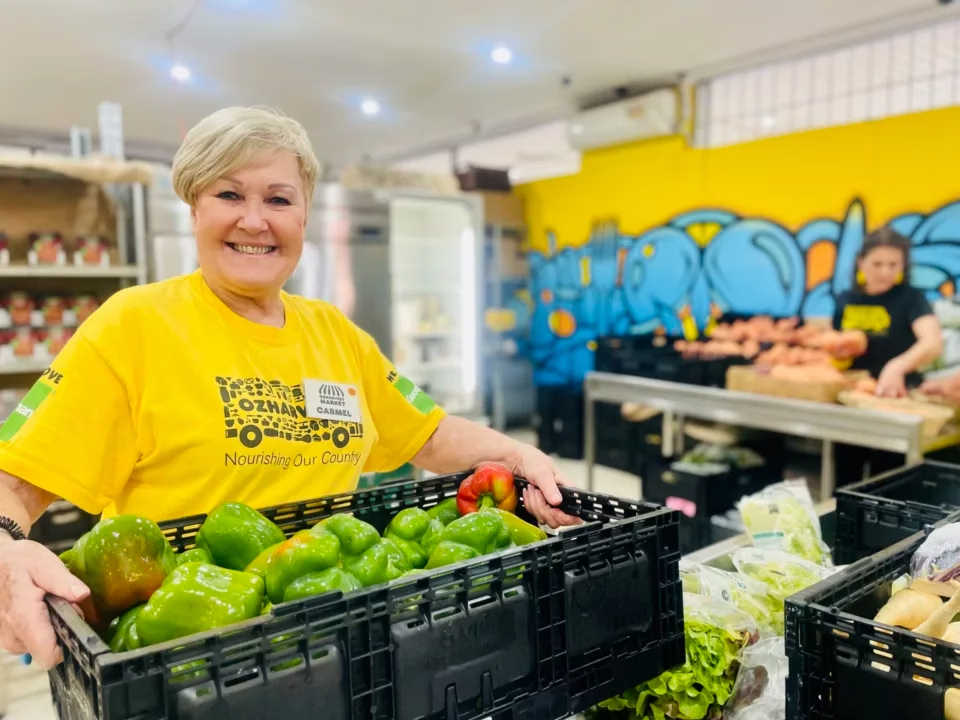
After a demanding year for many across our communities, AWS is proud to share that we have made a festive season donation to OzHarvest, Australia’s leading food rescue organisation, which will provide thousands of meals to Australians in need.

Thank you for reading this post, don't forget to subscribe!

A growing need in our communities

Food insecurity in Australia is rising at an alarming rate. Last year, an estimated 3.5 million households struggled to put food on the table, with the cost of living now the number one driver of hardship. The charities OzHarvest supports say they could distribute double the amount of food to meet demand. Every day, new people are turning up for help, often feeling ashamed or embarrassed to ask.

James from St Albans Community Youth Club in Victoria, which receives OzHarvest food weekly, put it simply: “For the first time in 10 years, we’re struggling to feed everyone.”

Why the festive season matters

The festive period can be especially difficult for families who do not know where their next meal is coming from. Demand typically spikes at this time of year, even as household budgets are stretched further. OzHarvest is working hard to ensure nourishing food reaches those who need it most, not just during the holidays but all year round.

About OzHarvest

OzHarvest was founded in 2004 by Ronni Kahn AO, after she noticed how much quality food was going to waste through her events business. What began as a simple, practical solution rescuing surplus food and delivering it to charities quickly grew from one van in Sydney into a nationwide movement. As OzHarvest expanded, Ronni and a team of pro bono lawyers successfully lobbied state governments to change legislation so food donors could give surplus food to charities without fear of liability. NSW led the way with the Civil Liabilities Amendment Act in 2005, and other states followed.

Today, OzHarvest rescues food at scale with a clear purpose to Nourish Our Country. Their mission is to stop food waste, feed people in need, and protect our planet by championing the value of food and driving change at every level of society. Their work strongly aligns with five United Nations Sustainable Development Goals.

How you can help (if you would like to)

OzHarvest welcomes every contribution. The impact is immediate and tangible.

  • $1 = 2 meals
  • Your donation helps keep OzHarvest’s wheels turning
  • It supports food relief for over 1,500 charities helping vulnerable Aussies every day

For more information or to make a donation visit: https://www.ozharvest.org/

Image credit: OzHarvest


Architectural Window Systems (AWS) is proud to sponsor the Murcutt Building Tours, a centrepiece of the inaugural Glenn Murcutt Architecture Foundation Symposium, to be held in Sydney from 11 – 13 September 2025.

Thank you for reading this post, don't forget to subscribe!

The Symposium, presented by the Murcutt Foundation, celebrates more than five decades of architectural practice by Glenn Murcutt AO, Australia’s most celebrated living architect. The program offers three days of tours, talks and events for architects, students and design professionals, culminating in a rare opportunity to engage directly with some of Murcutt’s most acclaimed works.

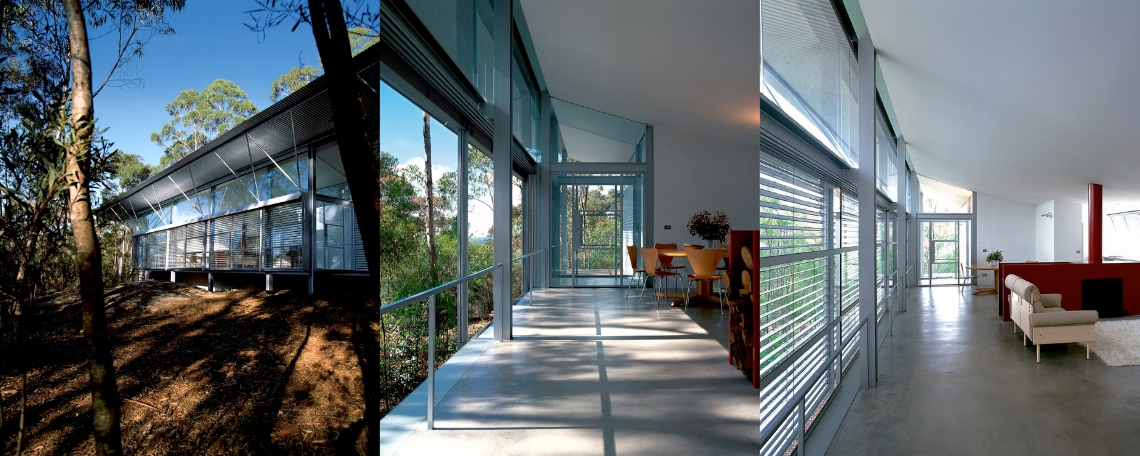
As part of its ongoing support for architectural excellence and sustainable, place-based design, AWS is sponsoring the Murcutt Building Tours on Thursday, 11 September, providing a rare, guided experience led by Murcutt himself through two iconic residential projects:

  • Nicholas House
  • Simpson Lee House

“I am so pleased that so many have taken the chance to see these two projects that were designed in such close collaboration with the clients at the time, and which have been so well loved and cared for over the many decades since. It is such a joy to share this work,” Glenn Murcutt AO.

“Glenn Murcutt’s works embody a profound sensitivity to landscape, climate and material — and they are best understood by being experienced firsthand,” said Angela Bevitt-Parr, National Marketing Manager at AWS. “AWS is proud to support this extraordinary opportunity for architects to deepen their understanding of Murcutt’s work and philosophy through direct engagement with these exceptional places.”

Beyond the tours, the Symposium will feature keynote addresses from Glenn Murcutt AO and Francis Kéré (fellow Pritzker Prize Laureate), the inaugural awarding of the Murcutt Pin, and a full day of talks exploring the themes that have informed Murcutt’s unique model of practice.

“Francis Kéré is one of the great humans, and a gifted architect who really shows architecture can make a difference in people’s lives. I have a huge amount of respect and time and a wonderful friendship with this man because of his integrity. I am so pleased that Sydney will get to meet him this year,” Glenn Murcutt AO.

For full event details and to register, visit: https://events.humanitix.com/murcutt-symposium

About the Glenn Murcutt Architecture Foundation: The Glenn Murcutt Architecture Foundation promotes the work and legacy of Glenn Murcutt AO through education, advocacy and public programs that advance environmentally responsible architecture and foster dialogue around design excellence and connection to place. For more information visit https://www.murcuttfoundation.org/

Image credit:

Simpson Lee house: Anthony Browell.


In late 1994, two dedicated fenestration professionals, Gavan Pead and David McCleary, took a pivotal tour of Architectural Profiles Ltd (APL) in Cambridge, New Zealand. Inspired by APL’s customer-focused business model, they envisioned bringing a similar approach to challenge the Australian market’s basic, outdated aluminium windows and doors that dominated at that time.

Thank you for reading this post, don't forget to subscribe!

This vision led to the founding of Architectural Window Systems (AWS) in January 1995, with Pead as the first General Manager and McCleary as Head of Design. AWS launched with the release of the 502 sliding window and 541 sliding door – affordable, single-glazed products that immediately stirred the market. “In those days, profiles were hand-drawn, and every detail required precise verification,” McCleary recalls. Their commitment to quality was matched by strong supplier support, relationships that remain solid today.

To bring this customer-centric model to life, AWS built a robust network of independent fabricators across Australia, now exceeding 200, with unparalleled reach and service capabilities. Steve Butcher of Great Lakes Glass, an early adopter, recalls that “their passion was infectious, and if they were starting something new, I wanted to be part of it.”

AWS quickly became a trusted name in high-performance aluminium windows, with products designed to meet the needs of architects, designers, builders, and homeowners. With the launch of ThermalHEART™ in 2007, followed by ThermalHEART™ commercial in 2012, AWS introduced its first thermally broken products, raising the bar for energy efficiency. In 2003, David’s son, Mark McCleary, joined AWS, continuing the family’s involvement in the company. In 2021, Mark took over the leadership of research and design, guiding the development of innovative window and door solutions. That same year, AWS introduced ComfortEDGE™, a significant step forward in thermal efficiency. With additional ComfortEDGE™ products set for release in 2025, AWS continues to strengthen its commitment to energy-efficient solutions for the Australian market.

Reflecting on the success of the last 30 years, AWS General Manager Greg Taylor notes that “it’s our model that differentiates us. A supplier that is not only an extrusion supplier, but a reliable, supportive, engaged business partner that understands the need for continuous improvement”.

In 2025, AWS will continue to focus on improvement, introducing a class-leading digital environment for specifiers, fabricators, and staff, along with an automated workflow connectivity solution exclusively for AWS fabricators.

For more information, contact marketing@awsaustralia.com.au