
Home > News > Scale, Collaboration And Competitions In Young Practice

Scale, Collaboration And Competitions In Young Practice

lets-see-Hero_banner

Scale, collaboration and competitions were common topics of discussion surrounding this week’s Tuesday Night Talk Series. The talk, the first in a series called Look-See, brought together four young practices and the architects at their helm to discuss their unique approaches to architecture. Despite a lack of specific briefing of topics to discuss, each had overlapping experiences of their journey founding their own firms. The talks covered the process of finding work, which scale to work at, the double-edged sword of competitions, and the importance of collaboration.

Thank you for reading this post, don't forget to subscribe!

Lucy Humphrey began the night with one of the more established practices, Archrival – a non-profit organisation she founded with Claire McCaughan in 2011. Their studio was established as an antidote to normal practise, a place for experimentation and challenges.

The practice began with an intention of never working for free, highlighting the amount of architectural energy spent and wasted in Expressions of Interest. However, as most architects would know, this was short lived, but it did generate a conversation of productive rivalry within architecture.

This set about the creation of a manifesto, which is ever changing in their business, adapting to their lessons learnt. The need to challenge standard practices, and retain the relevancy of architecture lead Archrival to behave more like a salon, architects and other creatives working competitively but collaboratively to produce great work across a variety of architectural and artistic mediums.  The proof is definitely in the pudding, with Archrival now having worked on hundreds of collaborations, each project with a public, spatial and functional qualities walking the line between art and architecture.

Following Lucy’s impassioned talk, was Jennifer McMaster of TRIAS, the newest of the practices which is run by Jennifer along with Jonathon Donnelly and Casey Bryant. Despite being a relative new practice, Trias has leveraged architectural competitions, both locally and internationally, to build their practice into a small but thriving business.

Trias are testament to the ability of competitions to breed real world work, and Jennifer highlighted they way in which each of their competitions have lead to architectural projects, media exposure, and created connections both professionally and with clients. The time and effort placed into each of their renders belies the passion Trias have for each of their competitions, which are treated as if they were a real project. Each one is reworked following the competition to make sure their absolute best work is achieved, just as an author wouldn’t publish their first manuscript.

The practice’s motto of solid, simple and beautiful is evident throughout all of their projects, and the idea of ‘polite radicalism’ is one which resounds with architects and clients alike.

Tomek Archer begins with his story of returning to architecture after his music allowed him to travel the world and inspire his passion for design. Archer Office, established by Tomek, was named as one of 20 emerging practices to watch around the world in 2016. The practice is very focused on scale and began work with small, well designed pieces of furniture. Unlike Trias which leveraged their competitions for more work, Archer focused on furniture design and installations, like Poly at the Sherman Contemporary Art Foundation, which led to media exposure and clients returning for architectural projects.

However as the practice has grown in scale, so too have the projects. Though most projects still have a strong focus on furniture design, like the Wine Quarter, Archer have taken on larger projects like shopping centres and senior lifestyle villages, and remain consistent to their integrated design approach.

Lastly, Sean Choo of Up (Urban Possible) takes the stage, to discuss the ways in which he and Simon Fleet have approached their practice. Like Archer Office, UP had a focus on scale, aiming to never be constrained by the scale of a project too small or too large. This has led to a large amount of  their work focusing on large scale multi-residential, in contrast to many of the other architects talking tonight.

UP believes in gaining the most amount of value from their architectural design and much of their work focuses on the front end of design, collaborating with larger firms for documentation and delivery of a project. Their attitude is that architecture is a negotiation and, like Trias, leveraged competitions for their earlier work. UP also accredit their collaboration with larger practices, to winning many larger projects – the stability of larger firms allowed them a sense of reliability which smaller, fresh practices often lack for larger tenders.

They believe this collaborative approach allows their practice to stay small and nimble, integrated thoroughly in the design practice, while drawing on the resources and experience of larger firms for more time intensive tasks like documentation. The rigour and time spent of design can be seen in the careful planning and site specific nature of each of their multi-residential projects

The end of night discussion led to some of the most interesting debate between the young architects, with each highlighting the difficulties in sorting a new practice and striving for work-life balance even if it isn’t always attainable. The message we are left with walking out of Tusculum is the necessity of collaboration in any practice, whether it be with other firms, consultants or a more productive competition.


Written by: Alexandra McRobert (NSW Event Correspondent for AWS)


Alexandra is a PhD Candidate at the University of Sydney and practising architectural graduate. Her research and work focuses on delivering affordable housing and prefabricated manufacturing techniques. Alexandra has also been involved in number of volunteer projects overseas, and spends a considerable amount of her spare time contemplating red wine and board games

Recent News

Architectural Window Systems (AWS) is proud to sponsor the Murcutt Building Tours, a centrepiece of the inaugural Glenn Murcutt Architecture Foundation Symposium, to be held in Sydney from 11 – 13 September 2025.

Thank you for reading this post, don't forget to subscribe!

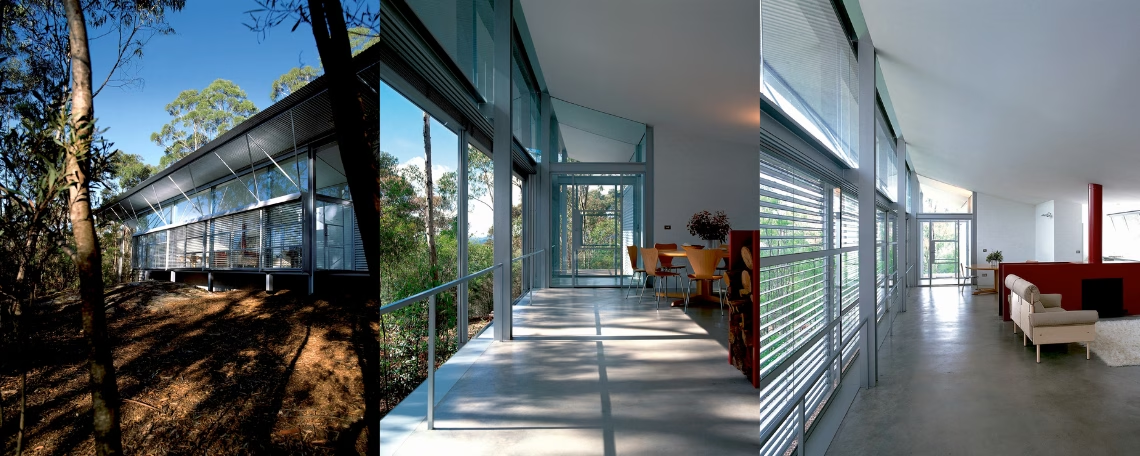
The Symposium, presented by the Murcutt Foundation, celebrates more than five decades of architectural practice by Glenn Murcutt AO, Australia’s most celebrated living architect. The program offers three days of tours, talks and events for architects, students and design professionals, culminating in a rare opportunity to engage directly with some of Murcutt’s most acclaimed works.

As part of its ongoing support for architectural excellence and sustainable, place-based design, AWS is sponsoring the Murcutt Building Tours on Thursday, 11 September, providing a rare, guided experience led by Murcutt himself through two iconic residential projects:

  • Nicholas House
  • Simpson Lee House

“I am so pleased that so many have taken the chance to see these two projects that were designed in such close collaboration with the clients at the time, and which have been so well loved and cared for over the many decades since. It is such a joy to share this work,” Glenn Murcutt AO.

“Glenn Murcutt’s works embody a profound sensitivity to landscape, climate and material — and they are best understood by being experienced firsthand,” said Angela Bevitt-Parr, National Marketing Manager at AWS. “AWS is proud to support this extraordinary opportunity for architects to deepen their understanding of Murcutt’s work and philosophy through direct engagement with these exceptional places.”

Beyond the tours, the Symposium will feature keynote addresses from Glenn Murcutt AO and Francis Kéré (fellow Pritzker Prize Laureate), the inaugural awarding of the Murcutt Pin, and a full day of talks exploring the themes that have informed Murcutt’s unique model of practice.

“Francis Kéré is one of the great humans, and a gifted architect who really shows architecture can make a difference in people’s lives. I have a huge amount of respect and time and a wonderful friendship with this man because of his integrity. I am so pleased that Sydney will get to meet him this year,” Glenn Murcutt AO.

For full event details and to register, visit: https://events.humanitix.com/murcutt-symposium

About the Glenn Murcutt Architecture Foundation: The Glenn Murcutt Architecture Foundation promotes the work and legacy of Glenn Murcutt AO through education, advocacy and public programs that advance environmentally responsible architecture and foster dialogue around design excellence and connection to place. For more information visit https://www.murcuttfoundation.org/

Image credit:

Simpson Lee house: Anthony Browell.


In late 1994, two dedicated fenestration professionals, Gavan Pead and David McCleary, took a pivotal tour of Architectural Profiles Ltd (APL) in Cambridge, New Zealand. Inspired by APL’s customer-focused business model, they envisioned bringing a similar approach to challenge the Australian market’s basic, outdated aluminium windows and doors that dominated at that time.

Thank you for reading this post, don't forget to subscribe!

This vision led to the founding of Architectural Window Systems (AWS) in January 1995, with Pead as the first General Manager and McCleary as Head of Design. AWS launched with the release of the 502 sliding window and 541 sliding door – affordable, single-glazed products that immediately stirred the market. “In those days, profiles were hand-drawn, and every detail required precise verification,” McCleary recalls. Their commitment to quality was matched by strong supplier support, relationships that remain solid today.

To bring this customer-centric model to life, AWS built a robust network of independent fabricators across Australia, now exceeding 200, with unparalleled reach and service capabilities. Steve Butcher of Great Lakes Glass, an early adopter, recalls that “their passion was infectious, and if they were starting something new, I wanted to be part of it.”

AWS quickly became a trusted name in high-performance aluminium windows, with products designed to meet the needs of architects, designers, builders, and homeowners. With the launch of ThermalHEART™ in 2007, followed by ThermalHEART™ commercial in 2012, AWS introduced its first thermally broken products, raising the bar for energy efficiency. In 2003, David’s son, Mark McCleary, joined AWS, continuing the family’s involvement in the company. In 2021, Mark took over the leadership of research and design, guiding the development of innovative window and door solutions. That same year, AWS introduced ComfortEDGE™, a significant step forward in thermal efficiency. With additional ComfortEDGE™ products set for release in 2025, AWS continues to strengthen its commitment to energy-efficient solutions for the Australian market.

Reflecting on the success of the last 30 years, AWS General Manager Greg Taylor notes that “it’s our model that differentiates us. A supplier that is not only an extrusion supplier, but a reliable, supportive, engaged business partner that understands the need for continuous improvement”.

In 2025, AWS will continue to focus on improvement, introducing a class-leading digital environment for specifiers, fabricators, and staff, along with an automated workflow connectivity solution exclusively for AWS fabricators.

For more information, contact marketing@awsaustralia.com.au

From roof colour to insulation, from appliances to landscaping, all the material selections made in a project form a part of the build’s overall sustainability.

Thank you for reading this post, don't forget to subscribe!

Architects and Building Designers are tasked with the most important objectives; managing client expectations, design intent, – and of course budget all within site parameters and building compliance.

When it comes to achieving or exceeding a 7-star energy rating as part of the National Construction Code, few of these choices offer as much scope for variation and flexibility as the selection and application of window and door systems as a major component of the thermal envelope of the building.

Well specified windows and doors can be the difference between a thermally efficient design which comes in on budget versus an over engineered, high performing build that can confuse the most experienced specifier and possibly exceed budget – perhaps unnecessarily.

Thermally broken windows have long held the title of one of the most energy efficient solutions by offering the broadest application for use. By insulating the pathway for thermal transmission through the window frame, it’s a clever way to make the most from the durability of aluminium while reducing its conductivity – but extra components inevitably mean more assembly and a comparatively higher price tag.

So, is there a cost-efficient way to maximise energy gains, while maintaining strength and design flexibility without turning to thermally broken windows?

That’s a question both asked and answered by leading supplier of aluminium windows and doors, AWS (Architectural Window Systems). This fundamental question was asked over 10 years ago and it led to the development of a more cost effective, energy efficient solution which also offers a contemporary design aesthetic in the current market.

Cue ComfortEDGE™

ComfortEDGE is an elegant, double-glazed solution for residential applications that rivals the energy efficiency of thermally broken products. Its embedded frames provide a sleek design comprising fewer components than thermally broken counterparts, making it a cost-effective, wholly Australian made option for Australian projects. ComfortEDGE recognises that clever design doesn’t have to be complicated, and skilfully minimises the amount of exposed frame by embedding into the timber reveal, insulating against the environment to improve energy efficiency and thermal comfort.

ComfortEDGE truly is the perfect meeting point of form and functionality. It’s stylish and high performing, with U Values as low as 1.9 – placing you in the best position to meet 7-star energy provisions while keeping your budgeton track.

Back to weighing up your options… How will you know if ComfortEDGE is right for your project?

AWS recommends consulting your specification expert early in the design process, taking a holistic approach to build sustainably and to meet energy compliance on budget. For designers looking to harness the vast possibilities afforded by Australian designed and manufactured architectural windows, give your AWS specifier team member a call and reap the rewards. (AWS 1300 026 189)