

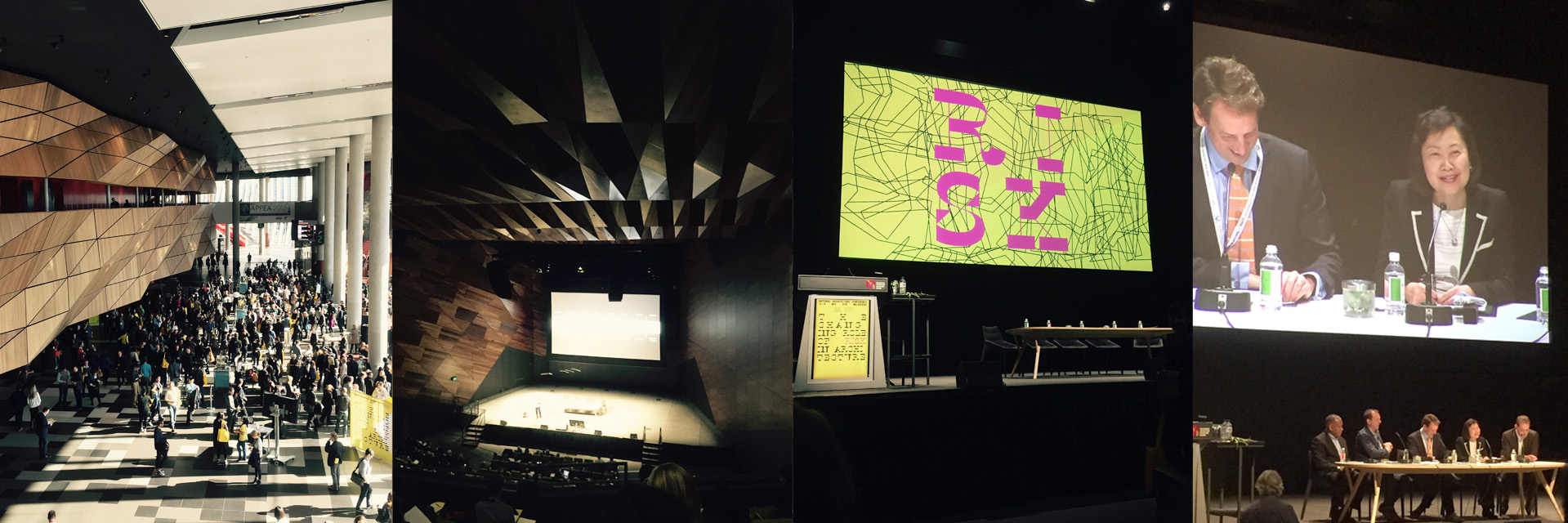
Every profession needs to pause every once in a while and ponder ‘Where are we headed?’ Or to phrase it more elegantly in Latin, ‘Quo Vadis?’ The annual National Architecture conference serves this purpose and more. This year the conference was held in Melbourne (at the Melbourne Convention Centre by NH Architecture and Woods Bagot) with the theme of Risk. The conference is delivered each year thanks to the generous support of the AIA’s key corporate sponsors, including Architectural Window Systems (AWS).
Thank you for reading this post, don't forget to subscribe!The profession is currently at a crossroads in Australia. The role of the Architect has become increasingly marginalized in projects large and small. The public often does not understand the value we can offer. Restrictive modes of practice and an increasingly litigious environment mean that Risk is the proverbial ‘monster under the bed’ that everyone fears or wants to eliminate.
But it is by actively engaging with Risk that Architecture can actually find new ways of practicing, new relevance to society and new outcomes. In choosing this theme itself the conference directors – Andrew Mackenzie, Hamish Lyon and Donald Bates – too have taken a bit of a punt as it is far from an alluring topic to many. They have also taken a gamble with the format of the event by choosing to balance keynote speakers with individual panel discussions. So that attendees are not simply spoken to, but can be part of a lively debate and leave with new opinions formed or our experiences re-affirmed.
Day 1 commenced with two keynote speakers – Greg Pasquarelli (ShOP Architects, New York) and Caroline Bos ( UN Studio, Netherlands). Greg presented a very slick series of anecdotes from various projects. Their approach to risk involved having ‘skin in the game’ by directly contracting the façade material, offering ‘sweat equity’ in projects or fighting ‘value engineering’ through unflinching discussions with clients about investment returns. At last, Architects who can dabble in MBA-speak!
“…it came in at 1% more cost than standard construction but resulted in 17% more sales figures. Absolute data that design can add value to a building!”
-Greg Pasquarelli, Director, ShOP Architects, New York
Dialogue 1 with Suzannah Waldron (Searle X Waldron Architecture, Australia), John Choi (CHROFI, Australia), Deborah Saunt (DSDHA, UK) and Andrew Mackenzie proved to be quite thought provoking. By choosing two young, local practices to present their projects, it was good to see the tone shift towards the challenges faced by emerging architects. The risks, even for small or inexpensive projects, are now disproportionally mitigated – making it harder for young practices to offer successful outcomes and further erodes the skill-base of tradesmen to deliver unique solutions.
“The Risk is not simply in failing, but that you will end up with something ordinary”
-Suzannah Waldron, Searle x Waldron Architecture, Melbourne
Panel Discussion – Planning + Architecture was a joint event held with the Planning Institute of Australia (PIA) who were also hosting their annual event in the city. The panel included ‘star-power’ in Greg Pasquarelli (ShOP Architects, New York) and David Gianotten (OMA, Hong Kong) but also quiet achievers such as Mitchell Silver (NYC Parks, New York) and Cheang Koon Hean (HDB, Singapore). Moderating the discussion was John Daley from the Grattan institute in Melbourne. Planners and Architects are often assumed to be in adversarial roles, however the topic focused on the positive outcomes that can come from collaboration instead.
“Planning rules are only a starting point. You need to initiate and drive dialogue with your site and brief.”
-Dr Cheang Koon Hean, Housing Development Board CEO, Singapore
Day 1 ended with keynote presentations from Deboarah Saunt (DSDHA, UK) and David Gianotten (OMA, Hong Kong). Deborah’s speech focused on the intersection of architecture, beauty and risk. Her projects reflected the familiar evolution of a practice from small to mid-sized and the challenges that this brings. Interestingly many of her commissions were as a result of recommendations from Planners who saw value in her approach.
(On the Architect’s role) “We place ourselves in the path of luck …burn the rule book, and start again.”
-Deborah Saunt, Director, DSDHA, UK
David’s work with OMA was at the super-sized scale of projects – however even these are not immune from risks. Being within this rarefied realm but not having a distinct ‘signature’ style continues to be a hazard they intentionally foster. A key lesson to be learnt from large practices like OMA is also how they constantly (re)shape their business model too.
Day 2 was a tough start, beginning as it did as a pre-coffee 9am on a Saturday morning. Keynote speakers at the morning session were Amanda Levete (AL-A, UK) and Jeremy Till (Central St Martins, UK) both from London. Amanda’s presentation was a pre-recorded film of her speech interspersed with the themes of her work and built examples. Levete is often interested in the cross-pollination of architecture with other disciplines and made a good case for how intuition and innovation can go hand-in-hand. She offered the conundrum that as architects we can often rule in favour of logic and rationale – but at the expense of what is good & noble in our output.
If there was a hand-down favourite of the conference, for many others and me it was Jeremy Till’s keynote speech. Pacing the stage, TED-talk style, Jeremy’s examination of Risk was the most in-depth and wide-ranging. No mean feat, given the general high quality of speakers. From the social aspects of risk, to its role in education and practice – Jeremy examined each and stripped away the layers to reveal new lessons. His speech was a call-to-arms asking Architects to ditch pragmatic acceptance and cynical disenchantment in favour of radical engagement.
“Do we remain hopeful? We have to…else we allow Risk to dominate us.”
-Jeremy Till, Central Saint Martins, UK
Panel Discussion: Pedagogy with academics Jeremy Till ( Central Saint Martins, UK), Anthony Burke (UTS, Sydney) and Vivian Mitsogianni (RMIT, Melbourne) and chaired by Donald Bates (LAB, Melbourne). In what initially promised to be a very dry topic, the panel topic soon took on a life of its own. While Vivian spoke of an experiment-led education and practice, Anthony outlined the workings of the ‘business’ of Architectural education. Jeremy put the cat amongst the pigeons by proclaiming :
All Architecture schools are the same. Systems of pedagogy continue to be stuck in the Beaux Arts big-daddy syndrome – Daddy teaches Johnny how to be …. Just like Daddy!
-Jeremy Till, Central Saint Martins, UK
But by accepting that education cannot teach everything that an Architect needs to know, Anthony offered it could move towards shorter, more specialized courses that allow students to ‘design’ their course based on their interests. But the questions remains if students are able to decide at such an early stage what sort of education they want.
Dialogue 6 with Thomas Bailey ( Room 11, Tasmania), Hannah Tribe (Tribe Studio, Sydney) and Kasper Jensen (3XN). Thomas’ presentation of his work occasionally felt like a poetry reading, which reflects the aura of their built and conceptual work. Hannah chose to present the findings of an informal client survey, only to discover that most at-risk segment of participants (clients) are often blissfully unaware of it!
“It is an extension of self through design. I had never thought about architecture in this way.” (quote from Clients of Tribe Studio)
-Hannah Tribe , Tribe Studio Architects, Sydney
Her poignant final anecdote about a bespoke home, which failed as a commodity during the re-sale process, had the audience collectively draw their breadth. The ensuing questions and discussions about the point at which Risk becomes its bitter twin, Blame, was an interesting one that I continue to ponder.
Day 2 and the conference concluded with keynote speeches from Cynthia Davidson (Anyone Corporation, USA) and Kasper Jensen (3XN, Denmark) . The conference ended with a (penultimate) bang in the form of Cynthia Davidson. In her quiet manner, she managed to shatter many illusions. Cynthia is living proof that to shape architecture, you do not need to be in architecture practice. Through her work editing Anyone magazine, she tapped into the design zeitgeist in a way that shaped the future discourse. Her approach to diluting the stronghold that imagery has on Architectural discussion is also to be lauded – for instance her insistence on avoiding a cover image for her magazine resulting in a cover postcard that would fall-off once the cellophane was unwrapped! Here was the quintessential quiet achiever who swept the audience off its feet.
“ Risk (lies in the) Future (which shapes the) Unknown (which leads to the) New”
– Cynthia Davidson, Anyone Corporation, USA
Kasper Jensen’s presentation ended with the simple parable that the profession is at risk if we don’t evolve constantly. Perhaps that is why we find ourselves currently so marginalized. Our notion of Architectural practice hasn’t evolved much in past decades, making us seem obsolete. Surely the time to take Risks is now. We need to regain lost ground, and fast. The conference succeeded in giving a platform to many speakers who challenged the definition of risk, practice as well as Architecture.
But where to from here? Many of the keynote speakers and panel discussions pointed to the innate optimism of Architects. More tellingly they suggested that we simply have no other choice. To paraphrase Cynthia Davidson, it is only optimists who can believe there IS a future.
Written by: Sonia Sarangi of Atelier Red + Black (Victorian Event Correspondent for AWS)
Sonia Sarangi is co-director of Atelier Red+Black, an emerging architecture practice in Melbourne. She has a Masters in Architecture from the University of Melbourne and has previously worked for a small practice (Melbourne) and large international practice (Singapore). She is a proud supporter of Parlour and firmly believes that good design enriches life. She can be found on Instagram: @thesarangi