Home > News > National Student Congress – People 2015

National Student Congress – People 2015

people_2015

If there is only one thing I would like you to remember from this blog post it is this : The extensive program, quality of speakers and brilliant workshops at the National Student Congress offer INCREDIBLE value for money! Now that you know please don’t keep that a secret, spread the word…

Thank you for reading this post, don't forget to subscribe!

And if you ever assumed that it was an event ‘aimed’ at students, you would be very wrong. The tone of all the speakers was firmly about shaping the future course of architecture, surely something that is relevant to us all.  

One has to applaud the congress directors – Mercedes Mambort, Darcy Zelenko and Tim Randall – for coming up with a wonderfully engaging format. Over 3 dense days of program, they managed to orchestrate a pace that was both fluid but captivating. And they did a great job of showcasing local design by deciding to host the event at unique venues over the course of the congress– Day 1 at Deakin Edge, Federation Square; Day 2 at Storey Hall, RMIT & Day 3 at Melbourne School of Design, University of Melbourne.  Their impressive choice of congress theme – People – is one that is otherwise often relegated to the fringes of architectural debate. 

“Each decision you make…you affect people. This is the responsibility of the designer.”

-Mercedes Mambort, Student Congress Creative director 

It is also noteworthy that at 10 separate presentation sessions PLUS panel discussions AND workshops, the Student congress was a massive undertaking and hence this blog post will limit itself to covering some personal favourites & highlights from the 3-day event.

Early on Day 1 we were regaled by a wonderfully insightful presentation by Byron Kinnard on the history of the Student Congress itself. With great finesse and plenty of amusing anecdotes up his sleeve, Byron impressed upon me that the Student Congress is well on its way to recouping its relevance and activist role.  This prediction materialized when it was later announced that the next congress would be hosted in Sydney on the topic of ‘Advocacy’.

Another highlight was the session titled  ‘Who is my Neighbour?’ and included presentations by Eugenia Lim (Assemble Papers, Australia) and Jeremy Mcleod (Breathe Architecture, Australia). If ever you needed evidence that it is optimists who are at the heart of meaningful change – these guys are living examples.  Eugenia touched on the topic of her personal, yet political, artworks as well as her editorial stance in her work for Assemble papers. Jeremy delivered an excellent presentation that spoke directly to the Gen Y’s in the room – asking them to think hard about their future choices.

“Who do you want to be? What do you want to work for?”

-Jeremy Mcleod, Breathe Architecture

 His work in the Commons offers a triple-bottom line approach that has people at its core. This has now formed the basis for the ‘Nightingale Model’,  IP which he is generously sharing with other Architects for free in order for them to facilitate change in the way affordable housing is procured. It firmly laid to rest the stereotype that Architects can’t be collegiate. 

‘The Antipodes’ –a session which included two practitioners at either ends of the earth : Helen Stout (Mitchell & Stout Architects, New Zealand) and Steve Larkin (Steve Larkin Associates, Ireland) was a delightful under-the-radar moment. Helen’s talk had me pondering the impact that travel can have on a practice’s ethos as it clearly has in their instance. She is also a stellar exampled of the power that a concerned (and informed) citizen can have to mobilize public opinion and shape a city in order to save it from poor urban planning decisions. 

(Advice to the audience) “ Don’t be Timid (in your Architectural ambitions)”

 -Helen Stout, Mithcell & Stout Architects

Steve Larkin’s built projects may be half-way around the world but echo the best qualities of iconic Australian architecture – they speak of and to their landscape , all the while embracing humble materials that are executed with craft. However the foundation of his oeuvre is a study of music and its intricacies (based on his background in Irish traditional music). How refreshing to not hear the usual tropes about form and function, but instead explore patterns of material, geography and reverberation!

“I have always thought of the word Form as Gestalt (in its meaning) – an idea manifested; not a description of the shape of a building”

 -Steve Larkin, Steve Larkin Architects

This was followed by a session titled Observing through a Lens – including a much-anticipated presentation by photographer John Gollings. His talk was surprisingly self-effacing, as he chose instead to focus on the triumvirate – the architect, the photographer and people/client – that are equally vital in the creation of an image. The ensuing panel discussion – which also included Peter Bennetts, Shannon McGrath & Nic Granleese – tackled the tricky role of people IN architectural imagery. Whilst photographers are often criticized for not including people in their images, it was revealed that often the client/editor/ architect is partly responsible for that decision. Gollings was also very forthright in admitting that there we are hard-wired to focus on the human face and hence people can constitute a distraction from the architecture, which the images are trying to ‘sell’. The panel did agree however that no brief was off-limits in the pursuit of the perfect hero-shot or moment. 

Day 1 concluded with the enigmatic but sincere presence of Sean Godsell. He immediately set about dismantling the aura of the starchitect around him by letting the audience choose which one of his projects they would like to hear about.  His was a freewheeling, deeply personal reflection on his journey around and into architecture. He also highlighted the importance of stamina in order to practice architecture, a message Gen Y would do well to heed in this age of instant gratification.

“I am also a student of Architecture. I have only been studying it for much longer than you have.”

 -Sean Godsell, Sean Godsell Architects

The climax of Day 2 would have to be the Workshop session. 15 of Melbourne best and brightest architectural practices played host to groups of up to 12 congress attendees in their offices. The brief was to tackle the idea of accommodating expanding communities (for instance asylum seekers) within existing urban fabric. More importantly they were a fantastic opportunity to take a peek into the nitty gritty of contemporary practice.  I attended the workshop session hosted by Kerstin Thompson at her Carlton office. Kerstin began by outlining the themes explored by her practice as viewed through the lens of typology. She then set the team the task of increasing the density of existing, built projects as a way of setting creative limitations that would challenge the notion of ‘how we live or would like to live’. I found the exercise and ensuing presentations to be very invigorating. I sincerely hope the workshop format becomes a Student Congress legacy.

As they say, you should always go out with a bang. The literal finale to the congress arrived in the form of Takaharu Tezuka (Tezuka Architects, Japan) on Day 3. Eliciting the most number of laughs in the 3-day event, his humorous and unpretentious approach made him an audience favourite. His work constantly seeks to encourage a variety of behavior and questions assumptions about human perception and habits. Archi-speak was distinctly absent and refreshingly replaced by images chock-full of how people occupy the spaces/surfaces of his built projects. All of this was backed up by his deep knowledge of engineering and research into materials. Suffice to say, it ended all to soon for me.

Each and every one of the congress speakers spoke directly to theme and to the (largely Gen Y) audience not as students, but as future decision makers who will wield immense power through their choices. 

Events like these often launch a thousand dreams.  As Victory Hugo once wisely observed… 

“ There is nothing like a Dream to create the Future. 

Utopia today…is flesh and blood tomorrow.”

Written by: Sonia Sarangi of Atelier Red + Black  (Victorian Event Correspondent for AWS)

Sonia Sarangi is co-director of Atelier Red+Black, an emerging architecture practice in Melbourne. She has a Masters in Architecture from the University of Melbourne and has previously worked for a small practice (Melbourne) and large international practice (Singapore). She is a proud supporter of Parlour and  firmly believes that good design enriches life.  She can be found on Instagram: @thesarangi


Recent News

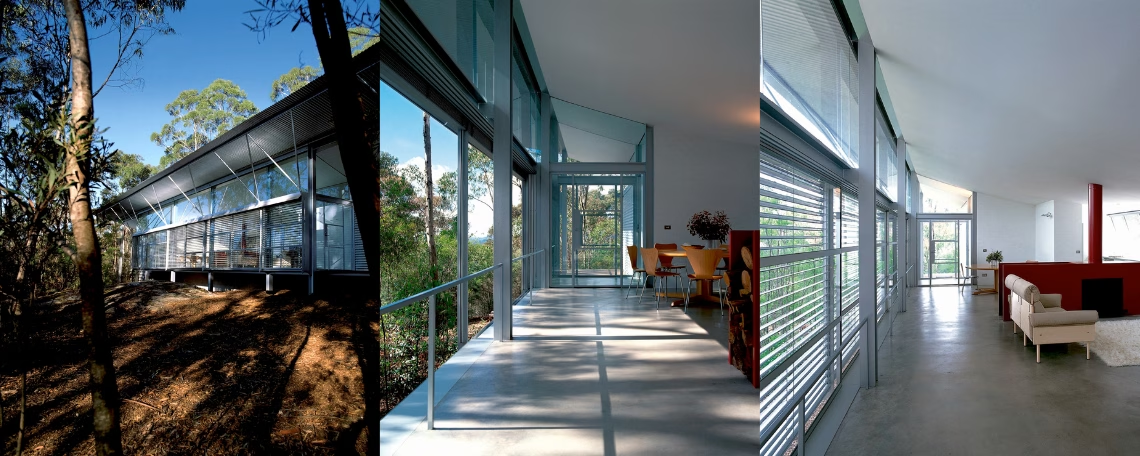
Architectural Window Systems (AWS) is proud to sponsor the Murcutt Building Tours, a centrepiece of the inaugural Glenn Murcutt Architecture Foundation Symposium, to be held in Sydney from 11 – 13 September 2025.

Thank you for reading this post, don't forget to subscribe!

The Symposium, presented by the Murcutt Foundation, celebrates more than five decades of architectural practice by Glenn Murcutt AO, Australia’s most celebrated living architect. The program offers three days of tours, talks and events for architects, students and design professionals, culminating in a rare opportunity to engage directly with some of Murcutt’s most acclaimed works.

As part of its ongoing support for architectural excellence and sustainable, place-based design, AWS is sponsoring the Murcutt Building Tours on Thursday, 11 September, providing a rare, guided experience led by Murcutt himself through two iconic residential projects:

  • Nicholas House
  • Simpson Lee House

“I am so pleased that so many have taken the chance to see these two projects that were designed in such close collaboration with the clients at the time, and which have been so well loved and cared for over the many decades since. It is such a joy to share this work,” Glenn Murcutt AO.

“Glenn Murcutt’s works embody a profound sensitivity to landscape, climate and material — and they are best understood by being experienced firsthand,” said Angela Bevitt-Parr, National Marketing Manager at AWS. “AWS is proud to support this extraordinary opportunity for architects to deepen their understanding of Murcutt’s work and philosophy through direct engagement with these exceptional places.”

Beyond the tours, the Symposium will feature keynote addresses from Glenn Murcutt AO and Francis Kéré (fellow Pritzker Prize Laureate), the inaugural awarding of the Murcutt Pin, and a full day of talks exploring the themes that have informed Murcutt’s unique model of practice.

“Francis Kéré is one of the great humans, and a gifted architect who really shows architecture can make a difference in people’s lives. I have a huge amount of respect and time and a wonderful friendship with this man because of his integrity. I am so pleased that Sydney will get to meet him this year,” Glenn Murcutt AO.

For full event details and to register, visit: https://events.humanitix.com/murcutt-symposium

About the Glenn Murcutt Architecture Foundation: The Glenn Murcutt Architecture Foundation promotes the work and legacy of Glenn Murcutt AO through education, advocacy and public programs that advance environmentally responsible architecture and foster dialogue around design excellence and connection to place. For more information visit https://www.murcuttfoundation.org/

Image credit:

Simpson Lee house: Anthony Browell.


In late 1994, two dedicated fenestration professionals, Gavan Pead and David McCleary, took a pivotal tour of Architectural Profiles Ltd (APL) in Cambridge, New Zealand. Inspired by APL’s customer-focused business model, they envisioned bringing a similar approach to challenge the Australian market’s basic, outdated aluminium windows and doors that dominated at that time.

Thank you for reading this post, don't forget to subscribe!

This vision led to the founding of Architectural Window Systems (AWS) in January 1995, with Pead as the first General Manager and McCleary as Head of Design. AWS launched with the release of the 502 sliding window and 541 sliding door – affordable, single-glazed products that immediately stirred the market. “In those days, profiles were hand-drawn, and every detail required precise verification,” McCleary recalls. Their commitment to quality was matched by strong supplier support, relationships that remain solid today.

To bring this customer-centric model to life, AWS built a robust network of independent fabricators across Australia, now exceeding 200, with unparalleled reach and service capabilities. Steve Butcher of Great Lakes Glass, an early adopter, recalls that “their passion was infectious, and if they were starting something new, I wanted to be part of it.”

AWS quickly became a trusted name in high-performance aluminium windows, with products designed to meet the needs of architects, designers, builders, and homeowners. With the launch of ThermalHEART™ in 2007, followed by ThermalHEART™ commercial in 2012, AWS introduced its first thermally broken products, raising the bar for energy efficiency. In 2003, David’s son, Mark McCleary, joined AWS, continuing the family’s involvement in the company. In 2021, Mark took over the leadership of research and design, guiding the development of innovative window and door solutions. That same year, AWS introduced ComfortEDGE™, a significant step forward in thermal efficiency. With additional ComfortEDGE™ products set for release in 2025, AWS continues to strengthen its commitment to energy-efficient solutions for the Australian market.

Reflecting on the success of the last 30 years, AWS General Manager Greg Taylor notes that “it’s our model that differentiates us. A supplier that is not only an extrusion supplier, but a reliable, supportive, engaged business partner that understands the need for continuous improvement”.

In 2025, AWS will continue to focus on improvement, introducing a class-leading digital environment for specifiers, fabricators, and staff, along with an automated workflow connectivity solution exclusively for AWS fabricators.

For more information, contact marketing@awsaustralia.com.au

From roof colour to insulation, from appliances to landscaping, all the material selections made in a project form a part of the build’s overall sustainability.

Thank you for reading this post, don't forget to subscribe!

Architects and Building Designers are tasked with the most important objectives; managing client expectations, design intent, – and of course budget all within site parameters and building compliance.

When it comes to achieving or exceeding a 7-star energy rating as part of the National Construction Code, few of these choices offer as much scope for variation and flexibility as the selection and application of window and door systems as a major component of the thermal envelope of the building.

Well specified windows and doors can be the difference between a thermally efficient design which comes in on budget versus an over engineered, high performing build that can confuse the most experienced specifier and possibly exceed budget – perhaps unnecessarily.

Thermally broken windows have long held the title of one of the most energy efficient solutions by offering the broadest application for use. By insulating the pathway for thermal transmission through the window frame, it’s a clever way to make the most from the durability of aluminium while reducing its conductivity – but extra components inevitably mean more assembly and a comparatively higher price tag.

So, is there a cost-efficient way to maximise energy gains, while maintaining strength and design flexibility without turning to thermally broken windows?

That’s a question both asked and answered by leading supplier of aluminium windows and doors, AWS (Architectural Window Systems). This fundamental question was asked over 10 years ago and it led to the development of a more cost effective, energy efficient solution which also offers a contemporary design aesthetic in the current market.

Cue ComfortEDGE™

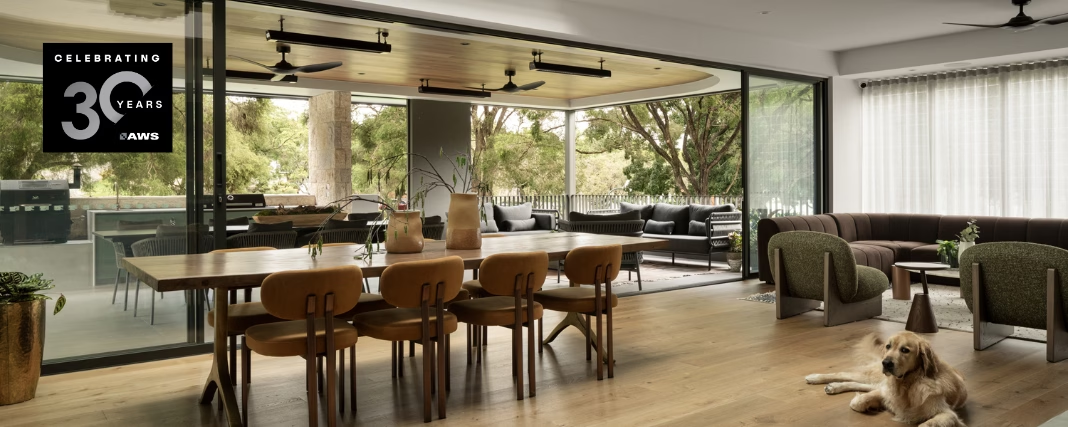
ComfortEDGE is an elegant, double-glazed solution for residential applications that rivals the energy efficiency of thermally broken products. Its embedded frames provide a sleek design comprising fewer components than thermally broken counterparts, making it a cost-effective, wholly Australian made option for Australian projects. ComfortEDGE recognises that clever design doesn’t have to be complicated, and skilfully minimises the amount of exposed frame by embedding into the timber reveal, insulating against the environment to improve energy efficiency and thermal comfort.

ComfortEDGE truly is the perfect meeting point of form and functionality. It’s stylish and high performing, with U Values as low as 1.9 – placing you in the best position to meet 7-star energy provisions while keeping your budgeton track.

Back to weighing up your options… How will you know if ComfortEDGE is right for your project?

AWS recommends consulting your specification expert early in the design process, taking a holistic approach to build sustainably and to meet energy compliance on budget. For designers looking to harness the vast possibilities afforded by Australian designed and manufactured architectural windows, give your AWS specifier team member a call and reap the rewards. (AWS 1300 026 189)