
Home > News > NSW Architecture Awards 10×10 – Residential Round Up

NSW Architecture Awards 10×10 – Residential Round Up

tuesdaystusculum_hero_banner

“Can we build something that can contribute to its environment?”

Thank you for reading this post, don't forget to subscribe!

Polly Harbison proposed as she recalled her approach to the ‘Balmoral House’, Residential Architecture (houses – new) winner at the NSW Australian Institute of Architect’s Awards earlier this month. Unknowingly, this question became the basis of discussion that linked the perspectives of each of the esteemed architects involved; how can one contribute to their context in a considerate, functional and artistic manner? 

Lending some insight into how successful architecture is produced, this collection of prestigious architect’s lead the crowd through their projects and highlighted the core factors of design that should be aspired for when designing lasting architecture. Harbison, went on to recall her approach to the Balmoral House, recalling that their intentions for the house were to use a “cohesive palette of materials throughout the house” to enhance the dramatic experience of the art that was to be contained within the residence. The result of this approach has attracted much acclaim from the broader architectural community, but more importantly from the surrounding residents of Balmoral; with neighbours commenting that Balmoral House has “inspired us to build again”.  Leading to an interesting question; can architecture that innovatively considers its context and offers something back to it’s surroundings have the potential to influence future design in the area and consequently contribute to the ongoing development of it’s environment?

Leading on from Harbison, Angelo Canalepas discussed his thoughts on what makes great residential design, proposing;

“Architecture is its own art”.

Canalepas referenced the balance between materiality, creative design and functionality as prime drivers that contribute to architecture holding an ornate place in real world art.  Going on to emphasise the point, Angelo explains successful architecture is born from the architects’ ability to seamlessly manage the needs of the client and builders, while simultaneously producing a finished product that has artistic integrity; in terms of its design, context, materiality and aesthetics.

Running with the theme of the night, context and its place in residential architecture, Ian Moore stepped up to walk us through the Howe Allen House. Moore illustrated once more that great architectural design is achieved through the way in which context and a consistent material palette are engaged and innovated. Moore goes on to state,

“the contemporary architectural language of this design may not consist of the original materials of the house, but we aimed to make it feel as though it could have been there initially”,

highlighting an interesting aspect of how residential architecture can be resourceful and respectful when it comes to designing around existing form. Creating a seamlessly light touch between the existing and new, in the case of Howe Allen House, the architecture acknowledges its past while simultaneously contemporising existing residential architecture.

We end this article asking the same question that was proposed to us by Polly Harbison, “Can we build something that can contribute to its environment?”  When it comes to residential architecture, as architects, it is important to consider how built form effects and reacts within its environment. This weeks panellists reminded us of that, illustrating that the key to successful residential design lies in the careful consideration of how to appropriately and innovatively analyse the brief, context and then clients needs, in a manner that is creative yet considerate upon it’s conversion from concept to built form. 

Panellists: Polly Harbison (Clinton Murray + Polly Harbison), Ben Green (Tzannes Associates), Angelo Candalepas (Candalepas Associates), Adam Haddow (SJB Architects), Eoghan Lewis (Eoghan Lewis Architects) Miriam Green (Tribe Studio Architects), Ian Moore (Ian Moore Architects), Matthew Pullinger (Hassell) and Reg Lark (Reg Lark Architect)

Written by: Ben Cohen of Studio GL (New South Wales Event Correspondent for AWS) 

Ben is a Sydney based Graduate Architect, who graduated from Sydney University with a Masters in Architecture. He recently begun work at Studio GL where he has been developing his interest in urban design; his role has involved developing graphic information, design and research for civic master planning and development of design principles for a range of projects relating to master planning and urban design.

Recent News

Architectural Window Systems (AWS) is proud to sponsor the Murcutt Building Tours, a centrepiece of the inaugural Glenn Murcutt Architecture Foundation Symposium, to be held in Sydney from 11 – 13 September 2025.

Thank you for reading this post, don't forget to subscribe!

The Symposium, presented by the Murcutt Foundation, celebrates more than five decades of architectural practice by Glenn Murcutt AO, Australia’s most celebrated living architect. The program offers three days of tours, talks and events for architects, students and design professionals, culminating in a rare opportunity to engage directly with some of Murcutt’s most acclaimed works.

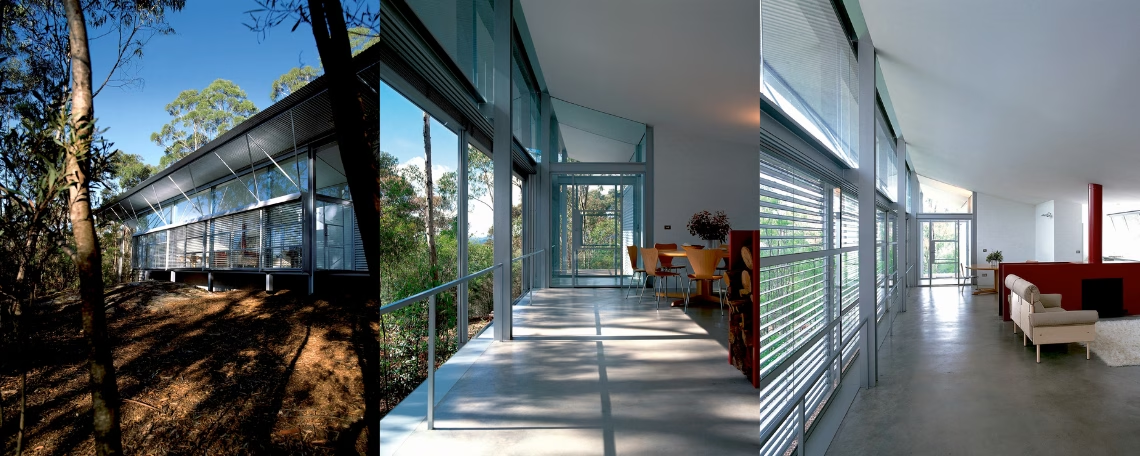
As part of its ongoing support for architectural excellence and sustainable, place-based design, AWS is sponsoring the Murcutt Building Tours on Thursday, 11 September, providing a rare, guided experience led by Murcutt himself through two iconic residential projects:

  • Nicholas House
  • Simpson Lee House

“I am so pleased that so many have taken the chance to see these two projects that were designed in such close collaboration with the clients at the time, and which have been so well loved and cared for over the many decades since. It is such a joy to share this work,” Glenn Murcutt AO.

“Glenn Murcutt’s works embody a profound sensitivity to landscape, climate and material — and they are best understood by being experienced firsthand,” said Angela Bevitt-Parr, National Marketing Manager at AWS. “AWS is proud to support this extraordinary opportunity for architects to deepen their understanding of Murcutt’s work and philosophy through direct engagement with these exceptional places.”

Beyond the tours, the Symposium will feature keynote addresses from Glenn Murcutt AO and Francis Kéré (fellow Pritzker Prize Laureate), the inaugural awarding of the Murcutt Pin, and a full day of talks exploring the themes that have informed Murcutt’s unique model of practice.

“Francis Kéré is one of the great humans, and a gifted architect who really shows architecture can make a difference in people’s lives. I have a huge amount of respect and time and a wonderful friendship with this man because of his integrity. I am so pleased that Sydney will get to meet him this year,” Glenn Murcutt AO.

For full event details and to register, visit: https://events.humanitix.com/murcutt-symposium

About the Glenn Murcutt Architecture Foundation: The Glenn Murcutt Architecture Foundation promotes the work and legacy of Glenn Murcutt AO through education, advocacy and public programs that advance environmentally responsible architecture and foster dialogue around design excellence and connection to place. For more information visit https://www.murcuttfoundation.org/

Image credit:

Simpson Lee house: Anthony Browell.


In late 1994, two dedicated fenestration professionals, Gavan Pead and David McCleary, took a pivotal tour of Architectural Profiles Ltd (APL) in Cambridge, New Zealand. Inspired by APL’s customer-focused business model, they envisioned bringing a similar approach to challenge the Australian market’s basic, outdated aluminium windows and doors that dominated at that time.

Thank you for reading this post, don't forget to subscribe!

This vision led to the founding of Architectural Window Systems (AWS) in January 1995, with Pead as the first General Manager and McCleary as Head of Design. AWS launched with the release of the 502 sliding window and 541 sliding door – affordable, single-glazed products that immediately stirred the market. “In those days, profiles were hand-drawn, and every detail required precise verification,” McCleary recalls. Their commitment to quality was matched by strong supplier support, relationships that remain solid today.

To bring this customer-centric model to life, AWS built a robust network of independent fabricators across Australia, now exceeding 200, with unparalleled reach and service capabilities. Steve Butcher of Great Lakes Glass, an early adopter, recalls that “their passion was infectious, and if they were starting something new, I wanted to be part of it.”

AWS quickly became a trusted name in high-performance aluminium windows, with products designed to meet the needs of architects, designers, builders, and homeowners. With the launch of ThermalHEART™ in 2007, followed by ThermalHEART™ commercial in 2012, AWS introduced its first thermally broken products, raising the bar for energy efficiency. In 2003, David’s son, Mark McCleary, joined AWS, continuing the family’s involvement in the company. In 2021, Mark took over the leadership of research and design, guiding the development of innovative window and door solutions. That same year, AWS introduced ComfortEDGE™, a significant step forward in thermal efficiency. With additional ComfortEDGE™ products set for release in 2025, AWS continues to strengthen its commitment to energy-efficient solutions for the Australian market.

Reflecting on the success of the last 30 years, AWS General Manager Greg Taylor notes that “it’s our model that differentiates us. A supplier that is not only an extrusion supplier, but a reliable, supportive, engaged business partner that understands the need for continuous improvement”.

In 2025, AWS will continue to focus on improvement, introducing a class-leading digital environment for specifiers, fabricators, and staff, along with an automated workflow connectivity solution exclusively for AWS fabricators.

For more information, contact marketing@awsaustralia.com.au

From roof colour to insulation, from appliances to landscaping, all the material selections made in a project form a part of the build’s overall sustainability.

Thank you for reading this post, don't forget to subscribe!

Architects and Building Designers are tasked with the most important objectives; managing client expectations, design intent, – and of course budget all within site parameters and building compliance.

When it comes to achieving or exceeding a 7-star energy rating as part of the National Construction Code, few of these choices offer as much scope for variation and flexibility as the selection and application of window and door systems as a major component of the thermal envelope of the building.

Well specified windows and doors can be the difference between a thermally efficient design which comes in on budget versus an over engineered, high performing build that can confuse the most experienced specifier and possibly exceed budget – perhaps unnecessarily.

Thermally broken windows have long held the title of one of the most energy efficient solutions by offering the broadest application for use. By insulating the pathway for thermal transmission through the window frame, it’s a clever way to make the most from the durability of aluminium while reducing its conductivity – but extra components inevitably mean more assembly and a comparatively higher price tag.

So, is there a cost-efficient way to maximise energy gains, while maintaining strength and design flexibility without turning to thermally broken windows?

That’s a question both asked and answered by leading supplier of aluminium windows and doors, AWS (Architectural Window Systems). This fundamental question was asked over 10 years ago and it led to the development of a more cost effective, energy efficient solution which also offers a contemporary design aesthetic in the current market.

Cue ComfortEDGE™

ComfortEDGE is an elegant, double-glazed solution for residential applications that rivals the energy efficiency of thermally broken products. Its embedded frames provide a sleek design comprising fewer components than thermally broken counterparts, making it a cost-effective, wholly Australian made option for Australian projects. ComfortEDGE recognises that clever design doesn’t have to be complicated, and skilfully minimises the amount of exposed frame by embedding into the timber reveal, insulating against the environment to improve energy efficiency and thermal comfort.

ComfortEDGE truly is the perfect meeting point of form and functionality. It’s stylish and high performing, with U Values as low as 1.9 – placing you in the best position to meet 7-star energy provisions while keeping your budgeton track.

Back to weighing up your options… How will you know if ComfortEDGE is right for your project?

AWS recommends consulting your specification expert early in the design process, taking a holistic approach to build sustainably and to meet energy compliance on budget. For designers looking to harness the vast possibilities afforded by Australian designed and manufactured architectural windows, give your AWS specifier team member a call and reap the rewards. (AWS 1300 026 189)