Home > News > Sliders V’s Bi-folds

Sliders V’s Bi-folds

Hero-Home

Bi-fold Doors

Thank you for reading this post, don't forget to subscribe!

Bi-fold Doors have a certain charm about them and throughout the 90’s and early 00’s they certainly were the product of choice for maximising openings between living and alfresco areas. Bi-fold Doors have a classic style and can give your space a “resort inspired” appearance. People often associate Bi-fold Doors as a more upmarket product.

Considerations when selecting a Bi-fold door system:

  • When opened, Bi-fold Door panels protrude into the outdoor space. A clear space must be maintained to allow the Bi-fold Door panels to fold out. Typically this means allowing approximately 1m wide along the full length of the door.
  • Screening is an important consideration. Retractable screening systems are ideal for Bi-fold Doors. The Centor™ SI retractable screening system is an ideal choice and clear market leader for screening Bi-fold Doors. If you are ordering a new Bi-fold Door from the Vantage® or Elevate™ range you can have it supplied and installed with the Centor™ S1 screen giving you a truly seamless solution.
  • Bi-fold Door panels are typically no more that 1m wide, this means you may require more panels with a Bi-fold door than  Siding door to span your opening. In turn this means there is more hardware involved in a Bi-fold door, more rollers, hinges, handles and operators. There is also more aluminium running vertically which means your view is more likely to be interrupted. Vantage® and Elevate™ Bi-fold Door systems use premium hardware so there is no cause for concern regarding durability or maintenance of the additional components, but because there is more involved Bi-fold Door systems can often be a little more expensive than Sliding Doors.
  • When selecting a Bi-fold Door for an area of your home which experiences high traffic you can consider configuring it as a 3+1 this means you would have 3 B-fold Door panels sliding in one direction and a single door opening on the other side, essentially this gives you the practicality of a double door opening – like French Doors for your day to day access and then the option to fully open the Bi-fold Doors when you are entertaining.
  • Sashless double-hung window panels can be installed into one of your Bi-fold Door panels if you would like the option of allowing ventilation without fully opening the bi-fold door just to get a breeze!

Sliding Doors, Cavity Sliding Doors and Stacking Doors

In recent times you may have noticed more and more new homes featuring big stacking sliding doors. Gone are the days of the 2100h x 1800w sliding door at the back of a home. Stacking sliding doors have meant wider openings, bigger views and bolder designs. Stacking doors within the Vantage® and Elevate™ product ranges can have up to 3 sliding panels + 1 fixed panel in each direction, want to go bigger you can double this and have what’s called a bi-parting stacking sliding door giving you a seriously wide opening. Like Bi-fold doors there are some important considerations when selecting Sliding Doors, Cavity Sliding Doors or Stacking Sliding Doors for your new home or renovation

Considerations when selecting sliding doors, cavity sliding doors and a stacking sliding door system:

  • A traditional Sliding Door system has 1 fixed panel and 1 sliding panel giving you a 50% opening. Stacking Sliding Doors can have up to 3 sliding panels and 1 fixed panel giving you up to a 75% opening.
  • Sliding Doors are often a practical choice for outdoor entertaining areas because they don’t protrude onto walkways
  • Sliding Doors can be easily screened with sliding flyscreens, you do need to keep in mind that the screens needs to slide on a track too, so if you have a 4 panel stacking sliding door with flyscreens you will end up with quite a wide sill or threshold. It is possible to fit stacking sliding doors with a retractable flyscreen. We recommend the Centor™ S1 retractable screen and offer it as a solution for the full range of Sliding Doors and Stacking Sliding Doors in the Vantage® and Elevate™ range.
  • You may wish to recess your Sliding Door sill into the floor to achieve a truly seamless transiting between the internal and external living spaces. Just keep in mind that if you choose to do this in your home your door will be exposed to the weather (i.e it’s not completely protected) you need to install the door with a secondary drainage solution – what is often referred to as a lineal or zero threshold drain. A slimline drain which sits outside alongside the sliding door system and will take care of any water which hits the sliding door or runs up against the door sill to ensure your sliding door continues to offer good water performance.
  • If you are installing a large sliding door with large heavy panels we recommend you choose a large D’Pull or handle like the ICON™ Sliding Door D’Pull, this will make the operation of the sliding door easier.
  • Sliding Doors can be installed in a Cavity Sliding configuration to achieve a 100% opening. This really is a smart design solution, but one which should be designed in early so you can ensure your cavity is wide enough and deep enough to accommodate the panels.
  • Corner Sliding Doors have become a really popular option, this is where you have two panels meeting a 90o junction with no post! It creates a brilliant open feeling for your space, but again needs to be thought about early so that it can be designed into your home as there can be no load above the door – and you will need to ensure the top of the door frame is properly supported.
  • Sliding Doors can be supported at the head or the sill, most run on bottom rolling rollers. If you are having big wide or heavy sliding door panels these rollers need to be up to the job! Vantage® and Elevate™ Sliding Doors, Cavity Sliding Doors and Stacking Sliding Doors use heavy duty running gear to cope with the heavy panels.
  • Sliding Door panels in the Elevate™ range can be up to 2.5mm wide each! Which means a door can span 8m! This means lovely uninterrupted views as there are not too many aluminium verticals interrupting the span. Certainly a high end choice for a new home.
  • There is typically less hardware and aluminium involved in creating a sliding door so these typically tend to be a little cheaper than an equivalent Bi-fold door system.

Recent News

Architectural Window Systems (AWS) is proud to sponsor the Murcutt Building Tours, a centrepiece of the inaugural Glenn Murcutt Architecture Foundation Symposium, to be held in Sydney from 11 – 13 September 2025.

Thank you for reading this post, don't forget to subscribe!

The Symposium, presented by the Murcutt Foundation, celebrates more than five decades of architectural practice by Glenn Murcutt AO, Australia’s most celebrated living architect. The program offers three days of tours, talks and events for architects, students and design professionals, culminating in a rare opportunity to engage directly with some of Murcutt’s most acclaimed works.

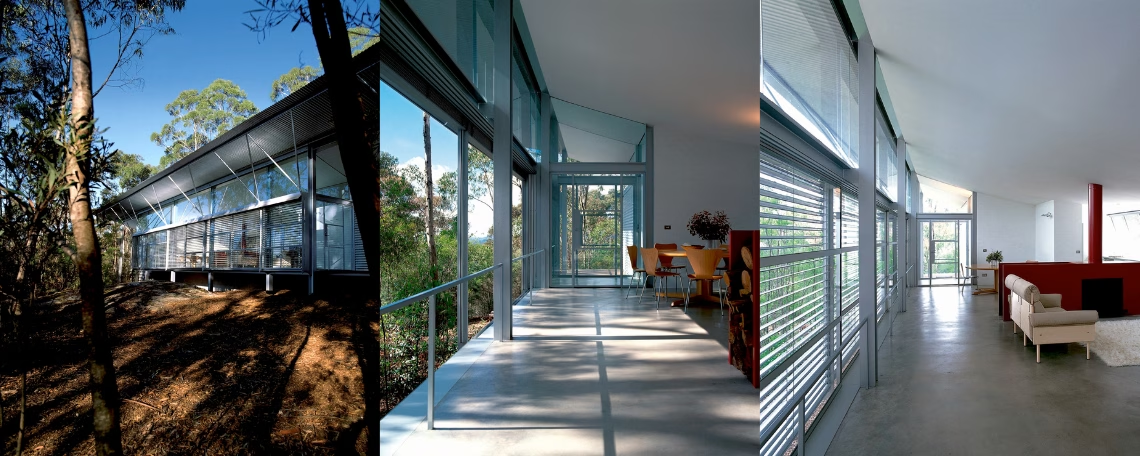
As part of its ongoing support for architectural excellence and sustainable, place-based design, AWS is sponsoring the Murcutt Building Tours on Thursday, 11 September, providing a rare, guided experience led by Murcutt himself through two iconic residential projects:

  • Nicholas House
  • Simpson Lee House

“I am so pleased that so many have taken the chance to see these two projects that were designed in such close collaboration with the clients at the time, and which have been so well loved and cared for over the many decades since. It is such a joy to share this work,” Glenn Murcutt AO.

“Glenn Murcutt’s works embody a profound sensitivity to landscape, climate and material — and they are best understood by being experienced firsthand,” said Angela Bevitt-Parr, National Marketing Manager at AWS. “AWS is proud to support this extraordinary opportunity for architects to deepen their understanding of Murcutt’s work and philosophy through direct engagement with these exceptional places.”

Beyond the tours, the Symposium will feature keynote addresses from Glenn Murcutt AO and Francis Kéré (fellow Pritzker Prize Laureate), the inaugural awarding of the Murcutt Pin, and a full day of talks exploring the themes that have informed Murcutt’s unique model of practice.

“Francis Kéré is one of the great humans, and a gifted architect who really shows architecture can make a difference in people’s lives. I have a huge amount of respect and time and a wonderful friendship with this man because of his integrity. I am so pleased that Sydney will get to meet him this year,” Glenn Murcutt AO.

For full event details and to register, visit: https://events.humanitix.com/murcutt-symposium

About the Glenn Murcutt Architecture Foundation: The Glenn Murcutt Architecture Foundation promotes the work and legacy of Glenn Murcutt AO through education, advocacy and public programs that advance environmentally responsible architecture and foster dialogue around design excellence and connection to place. For more information visit https://www.murcuttfoundation.org/

Image credit:

Simpson Lee house: Anthony Browell.


In late 1994, two dedicated fenestration professionals, Gavan Pead and David McCleary, took a pivotal tour of Architectural Profiles Ltd (APL) in Cambridge, New Zealand. Inspired by APL’s customer-focused business model, they envisioned bringing a similar approach to challenge the Australian market’s basic, outdated aluminium windows and doors that dominated at that time.

Thank you for reading this post, don't forget to subscribe!

This vision led to the founding of Architectural Window Systems (AWS) in January 1995, with Pead as the first General Manager and McCleary as Head of Design. AWS launched with the release of the 502 sliding window and 541 sliding door – affordable, single-glazed products that immediately stirred the market. “In those days, profiles were hand-drawn, and every detail required precise verification,” McCleary recalls. Their commitment to quality was matched by strong supplier support, relationships that remain solid today.

To bring this customer-centric model to life, AWS built a robust network of independent fabricators across Australia, now exceeding 200, with unparalleled reach and service capabilities. Steve Butcher of Great Lakes Glass, an early adopter, recalls that “their passion was infectious, and if they were starting something new, I wanted to be part of it.”

AWS quickly became a trusted name in high-performance aluminium windows, with products designed to meet the needs of architects, designers, builders, and homeowners. With the launch of ThermalHEART™ in 2007, followed by ThermalHEART™ commercial in 2012, AWS introduced its first thermally broken products, raising the bar for energy efficiency. In 2003, David’s son, Mark McCleary, joined AWS, continuing the family’s involvement in the company. In 2021, Mark took over the leadership of research and design, guiding the development of innovative window and door solutions. That same year, AWS introduced ComfortEDGE™, a significant step forward in thermal efficiency. With additional ComfortEDGE™ products set for release in 2025, AWS continues to strengthen its commitment to energy-efficient solutions for the Australian market.

Reflecting on the success of the last 30 years, AWS General Manager Greg Taylor notes that “it’s our model that differentiates us. A supplier that is not only an extrusion supplier, but a reliable, supportive, engaged business partner that understands the need for continuous improvement”.

In 2025, AWS will continue to focus on improvement, introducing a class-leading digital environment for specifiers, fabricators, and staff, along with an automated workflow connectivity solution exclusively for AWS fabricators.

For more information, contact marketing@awsaustralia.com.au

From roof colour to insulation, from appliances to landscaping, all the material selections made in a project form a part of the build’s overall sustainability.

Thank you for reading this post, don't forget to subscribe!

Architects and Building Designers are tasked with the most important objectives; managing client expectations, design intent, – and of course budget all within site parameters and building compliance.

When it comes to achieving or exceeding a 7-star energy rating as part of the National Construction Code, few of these choices offer as much scope for variation and flexibility as the selection and application of window and door systems as a major component of the thermal envelope of the building.

Well specified windows and doors can be the difference between a thermally efficient design which comes in on budget versus an over engineered, high performing build that can confuse the most experienced specifier and possibly exceed budget – perhaps unnecessarily.

Thermally broken windows have long held the title of one of the most energy efficient solutions by offering the broadest application for use. By insulating the pathway for thermal transmission through the window frame, it’s a clever way to make the most from the durability of aluminium while reducing its conductivity – but extra components inevitably mean more assembly and a comparatively higher price tag.

So, is there a cost-efficient way to maximise energy gains, while maintaining strength and design flexibility without turning to thermally broken windows?

That’s a question both asked and answered by leading supplier of aluminium windows and doors, AWS (Architectural Window Systems). This fundamental question was asked over 10 years ago and it led to the development of a more cost effective, energy efficient solution which also offers a contemporary design aesthetic in the current market.

Cue ComfortEDGE™

ComfortEDGE is an elegant, double-glazed solution for residential applications that rivals the energy efficiency of thermally broken products. Its embedded frames provide a sleek design comprising fewer components than thermally broken counterparts, making it a cost-effective, wholly Australian made option for Australian projects. ComfortEDGE recognises that clever design doesn’t have to be complicated, and skilfully minimises the amount of exposed frame by embedding into the timber reveal, insulating against the environment to improve energy efficiency and thermal comfort.

ComfortEDGE truly is the perfect meeting point of form and functionality. It’s stylish and high performing, with U Values as low as 1.9 – placing you in the best position to meet 7-star energy provisions while keeping your budgeton track.

Back to weighing up your options… How will you know if ComfortEDGE is right for your project?

AWS recommends consulting your specification expert early in the design process, taking a holistic approach to build sustainably and to meet energy compliance on budget. For designers looking to harness the vast possibilities afforded by Australian designed and manufactured architectural windows, give your AWS specifier team member a call and reap the rewards. (AWS 1300 026 189)