Home > News > Thermal Break Technology

Thermal Break Technology

Hero-Home

Understanding Thermal Break Technology

Thank you for reading this post, don't forget to subscribe!

Over the past five years an increasing number of window and door manufacturers within Australia have added thermally broken aluminum window and door systems to their product portfolio. Growing awareness of and demand for energy efficient building materials has driven product development in this area, resulting in an offering of window and door systems that deliver significant improvements in thermal efficiency and insulation properties.

Within Australia thermally broken aluminium window systems typically utilise one of two technologies to achieve the desired outcome of minimising heat transfer through the aluminium frame: pouring and de-bridging; or strut and spacer otherwise known as extrusion zipping.

1. Pouring and de-bridging

In thermally broken window systems using pour and de-bridge technology the window frame is first extruded as a single piece incorporating a hollow trough in the center. This hollow trough is then filled with a plastic that hardens to form an intermediate piece.

The connecting piece of aluminium is milled away leaving only the injected plastic to join the two halves of aluminium. Functionally the resulting piece is cut, mitred and assembled like a simple aluminium extrusion. Thermally the plastic slows the heat flow between the inside and the outside.

2. Extrusion zipping

In thermally broken window systems using extrusion zipping/ strut and spacer technology, individual extrusions are designed and extruded for the interior and exterior elements of the aluminium frame. These profiles are then joined using a number of polyamide strips, carefully positioned to maximise the insulation properties of the window. The strips are knurled and clamped between the interior and exterior aluminum elements and a machine is used to ‘zip’ the strips to the aluminium, creating a single profile with the same strength and expansion properties as a traditional aluminium window frame ensuring long-term functionality and durability.


AWS ThermalHEART™

Architectural Window Systems (AWS) developed a thermally broken range of aluminium windows and doors in 2008. The initial product release included sliding door, bi-fold door, hinged door and awning window systems. Since then the range has continued to expand and now includes a comprehensive offering of CentreGLAZE™ and FrontGLAZE™ framing in 100mm and 150mm platforms, along with compatible door systems for hinged, pivot, bi-fold or sliding installations.

“We’ve worked hard to make sure we can offer architects and designers a full and complete range of thermally broken systems for their projects, which will deliver excellent performance outcomes,” comments AWS Designer Mark McCleary.

McCleary cites one of the major challenges in developing a thermally broken window system was ensuring the size of the profiles was consistent with that of traditional non-thermally broken framing. “In Australia, architects and builders commonly work with 100mm and 150mm framing platforms. When you are incorporating a thermal break into the system you need to ensure the break is wide enough to give the insulation improvements you’re looking for, without making the profiles overly large or inconsistent with market expectations.

“We chose to use an extrusion zipping method to achieve our thermal break; this method allows you to create a true, wide break in the aluminium to maximise the thermal performance. The polyamide strips that provide the insulation are very stable and have similar strength and expansion properties as aluminium to ensure the finished thermally broken profiles are highly stable, consistent and strong. An added bonus with this method is the ability to offer dual colour extrusions – one colour inside, one colour outside -something previously unavailable to the Australian market, which really adds some flexibility for architects.

“When architects choose ThermalHEART™ they can work with the extrusions like they would any other commercial framing; it’s proportionally the same. Our ThermalHEART™ systems have the same strength, durability and expansion properties as non-thermally broken framing, the systems are easy to specify, they are l00 per cent Australian designed to suit the Australian climate and market, and they solve many problems associated with Section J compliance,” says McCleary.

 

Recent News

Architectural Window Systems (AWS) is proud to sponsor the Murcutt Building Tours, a centrepiece of the inaugural Glenn Murcutt Architecture Foundation Symposium, to be held in Sydney from 11 – 13 September 2025.

Thank you for reading this post, don't forget to subscribe!

The Symposium, presented by the Murcutt Foundation, celebrates more than five decades of architectural practice by Glenn Murcutt AO, Australia’s most celebrated living architect. The program offers three days of tours, talks and events for architects, students and design professionals, culminating in a rare opportunity to engage directly with some of Murcutt’s most acclaimed works.

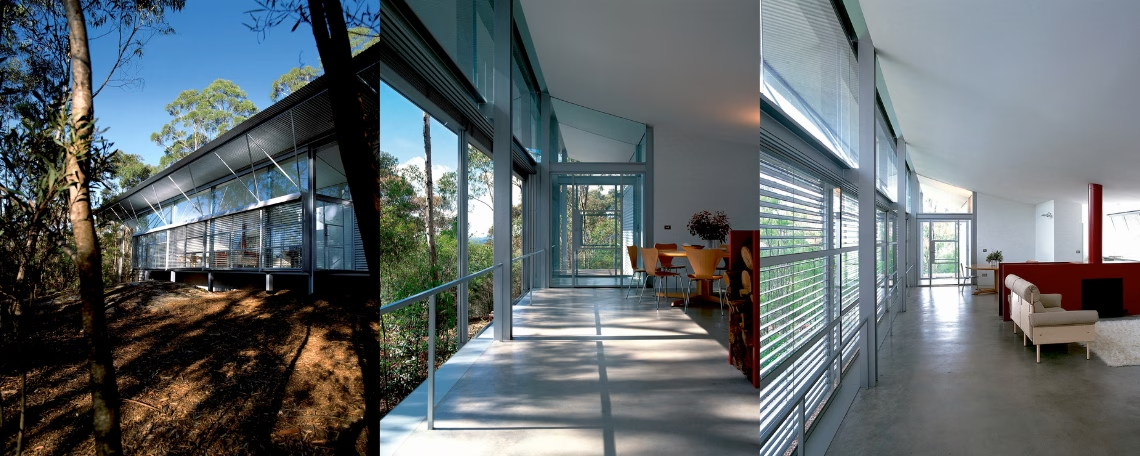
As part of its ongoing support for architectural excellence and sustainable, place-based design, AWS is sponsoring the Murcutt Building Tours on Thursday, 11 September, providing a rare, guided experience led by Murcutt himself through two iconic residential projects:

  • Nicholas House
  • Simpson Lee House

“I am so pleased that so many have taken the chance to see these two projects that were designed in such close collaboration with the clients at the time, and which have been so well loved and cared for over the many decades since. It is such a joy to share this work,” Glenn Murcutt AO.

“Glenn Murcutt’s works embody a profound sensitivity to landscape, climate and material — and they are best understood by being experienced firsthand,” said Angela Bevitt-Parr, National Marketing Manager at AWS. “AWS is proud to support this extraordinary opportunity for architects to deepen their understanding of Murcutt’s work and philosophy through direct engagement with these exceptional places.”

Beyond the tours, the Symposium will feature keynote addresses from Glenn Murcutt AO and Francis Kéré (fellow Pritzker Prize Laureate), the inaugural awarding of the Murcutt Pin, and a full day of talks exploring the themes that have informed Murcutt’s unique model of practice.

“Francis Kéré is one of the great humans, and a gifted architect who really shows architecture can make a difference in people’s lives. I have a huge amount of respect and time and a wonderful friendship with this man because of his integrity. I am so pleased that Sydney will get to meet him this year,” Glenn Murcutt AO.

For full event details and to register, visit: https://events.humanitix.com/murcutt-symposium

About the Glenn Murcutt Architecture Foundation: The Glenn Murcutt Architecture Foundation promotes the work and legacy of Glenn Murcutt AO through education, advocacy and public programs that advance environmentally responsible architecture and foster dialogue around design excellence and connection to place. For more information visit https://www.murcuttfoundation.org/

Image credit:

Simpson Lee house: Anthony Browell.


In late 1994, two dedicated fenestration professionals, Gavan Pead and David McCleary, took a pivotal tour of Architectural Profiles Ltd (APL) in Cambridge, New Zealand. Inspired by APL’s customer-focused business model, they envisioned bringing a similar approach to challenge the Australian market’s basic, outdated aluminium windows and doors that dominated at that time.

Thank you for reading this post, don't forget to subscribe!

This vision led to the founding of Architectural Window Systems (AWS) in January 1995, with Pead as the first General Manager and McCleary as Head of Design. AWS launched with the release of the 502 sliding window and 541 sliding door – affordable, single-glazed products that immediately stirred the market. “In those days, profiles were hand-drawn, and every detail required precise verification,” McCleary recalls. Their commitment to quality was matched by strong supplier support, relationships that remain solid today.

To bring this customer-centric model to life, AWS built a robust network of independent fabricators across Australia, now exceeding 200, with unparalleled reach and service capabilities. Steve Butcher of Great Lakes Glass, an early adopter, recalls that “their passion was infectious, and if they were starting something new, I wanted to be part of it.”

AWS quickly became a trusted name in high-performance aluminium windows, with products designed to meet the needs of architects, designers, builders, and homeowners. With the launch of ThermalHEART™ in 2007, followed by ThermalHEART™ commercial in 2012, AWS introduced its first thermally broken products, raising the bar for energy efficiency. In 2003, David’s son, Mark McCleary, joined AWS, continuing the family’s involvement in the company. In 2021, Mark took over the leadership of research and design, guiding the development of innovative window and door solutions. That same year, AWS introduced ComfortEDGE™, a significant step forward in thermal efficiency. With additional ComfortEDGE™ products set for release in 2025, AWS continues to strengthen its commitment to energy-efficient solutions for the Australian market.

Reflecting on the success of the last 30 years, AWS General Manager Greg Taylor notes that “it’s our model that differentiates us. A supplier that is not only an extrusion supplier, but a reliable, supportive, engaged business partner that understands the need for continuous improvement”.

In 2025, AWS will continue to focus on improvement, introducing a class-leading digital environment for specifiers, fabricators, and staff, along with an automated workflow connectivity solution exclusively for AWS fabricators.

For more information, contact marketing@awsaustralia.com.au

From roof colour to insulation, from appliances to landscaping, all the material selections made in a project form a part of the build’s overall sustainability.

Thank you for reading this post, don't forget to subscribe!

Architects and Building Designers are tasked with the most important objectives; managing client expectations, design intent, – and of course budget all within site parameters and building compliance.

When it comes to achieving or exceeding a 7-star energy rating as part of the National Construction Code, few of these choices offer as much scope for variation and flexibility as the selection and application of window and door systems as a major component of the thermal envelope of the building.

Well specified windows and doors can be the difference between a thermally efficient design which comes in on budget versus an over engineered, high performing build that can confuse the most experienced specifier and possibly exceed budget – perhaps unnecessarily.

Thermally broken windows have long held the title of one of the most energy efficient solutions by offering the broadest application for use. By insulating the pathway for thermal transmission through the window frame, it’s a clever way to make the most from the durability of aluminium while reducing its conductivity – but extra components inevitably mean more assembly and a comparatively higher price tag.

So, is there a cost-efficient way to maximise energy gains, while maintaining strength and design flexibility without turning to thermally broken windows?

That’s a question both asked and answered by leading supplier of aluminium windows and doors, AWS (Architectural Window Systems). This fundamental question was asked over 10 years ago and it led to the development of a more cost effective, energy efficient solution which also offers a contemporary design aesthetic in the current market.

Cue ComfortEDGE™

ComfortEDGE is an elegant, double-glazed solution for residential applications that rivals the energy efficiency of thermally broken products. Its embedded frames provide a sleek design comprising fewer components than thermally broken counterparts, making it a cost-effective, wholly Australian made option for Australian projects. ComfortEDGE recognises that clever design doesn’t have to be complicated, and skilfully minimises the amount of exposed frame by embedding into the timber reveal, insulating against the environment to improve energy efficiency and thermal comfort.

ComfortEDGE truly is the perfect meeting point of form and functionality. It’s stylish and high performing, with U Values as low as 1.9 – placing you in the best position to meet 7-star energy provisions while keeping your budgeton track.

Back to weighing up your options… How will you know if ComfortEDGE is right for your project?

AWS recommends consulting your specification expert early in the design process, taking a holistic approach to build sustainably and to meet energy compliance on budget. For designers looking to harness the vast possibilities afforded by Australian designed and manufactured architectural windows, give your AWS specifier team member a call and reap the rewards. (AWS 1300 026 189)